

This post has been updated for the 2025-2028 Racing Rules of Sailing.
Think you know the race signals? Here is a summary of every race signal in the 2025-2028 Racing Rules of Sailing (RRS), followed by a quiz to check yourself.
There is one change for 2025-2028. The three abandonment signals (N, N over H and N over A) now say “All races in progress are abandoned.” Every other signal and its sounds are unchanged.
Why the Change?
Optional reading. Skip ahead to Race Signals Summary if you like.
The change comes from Submission 002-23 (US Sailing). Its purpose was to “Describe abandonment signals in Race Signals clearly and in line with the general usage of those signals.” Two of its reasons:
- “‘Races that have started’ is not what is meant. All races that have finished have started, but we do not intend those races to be abandoned when N is displayed. What we want is to abandon only races in progress.”
- “The current descriptions of race signals N over H and N over A could be (and have been) interpreted as abandoning all races for the day, including those that have started and finished.”
World Sailing amended the proposal before approving it. The effect: N, N over H and N over A all abandon only races in progress, not races that have already finished.
Sources: 2023 Submissions (002-23); WS Study Version, Race Signals.
Race Signals Summary
The meanings of visual and sound signals are stated below. An arrow pointing up or down (↑↓) means that a visual signal is displayed or removed. A dot (•) means a sound; five short dashes (– – – – –) mean repetitive sounds; a long dash (—) means a long sound. When a visual signal is displayed over a class flag, fleet flag, event flag or race area flag, the signal applies only to that class, fleet, event or race area.
World Sailing, Racing Rules of Sailing 2025-2028 (Study Version), Race Signals. Read them online at racingrulesofsailing.org.
In the table, the meanings are the official wording. Flag images are from SailZing’s library; there is no image for the numeral pennants 1–9. The sounds are written out in words from the dots and dashes in the rule book.
Sources: meanings from the WS Study Version, Race Signals (same wording on racingrulesofsailing.org). Sounds read from the Study Version’s Race Signals page images.
| Signal | Sounds | Meaning |
|---|---|---|
| Postponement | ||
AP | 2 when displayed, 1 when removed | Races not started are postponed. The warning signal will be made 1 minute after removal unless at that time the race is postponed again or abandoned. |
AP over H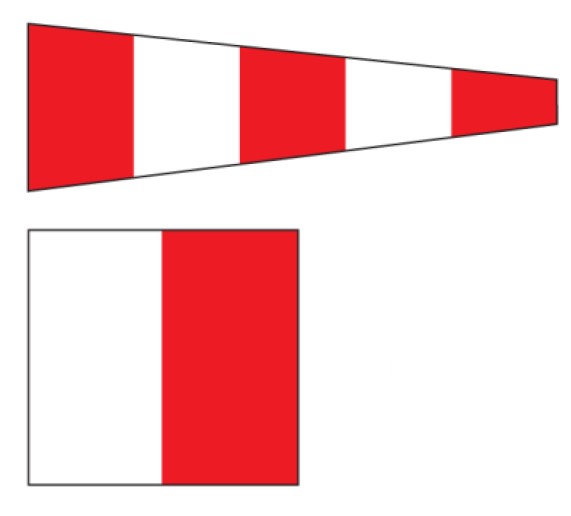 | 2 when displayed | Races not started are postponed. Further signals ashore. |
AP over A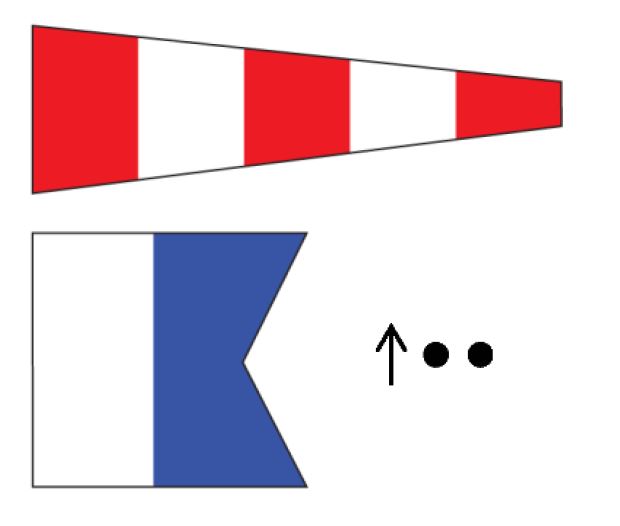 | 2 when displayed | Races not started are postponed. No more racing today. |
| AP over a numeral pennant 1–9 | 2 when displayed, 1 when removed | Postponement of 1-9 hours from the scheduled starting time. |
| Abandonment | ||
N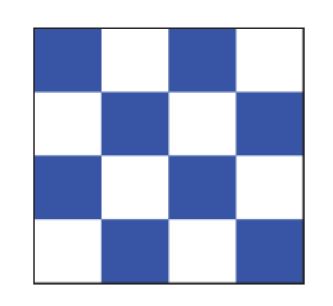 | 3 when displayed, 1 when removed | All races in progress are abandoned. Return to the starting area. The warning signal will be made 1 minute after removal unless at that time the race is abandoned again or postponed. |
N over H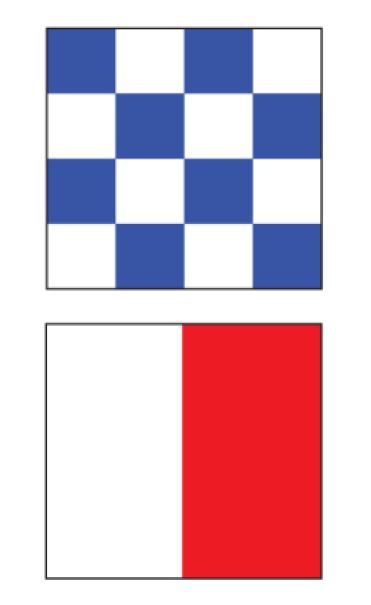 | 3 when displayed | All races in progress are abandoned. Further signals ashore. |
N over A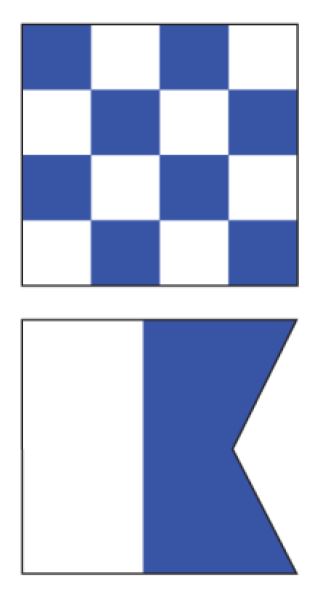 | 3 when displayed | All races in progress are abandoned. No more racing today. |
| Safety | ||
V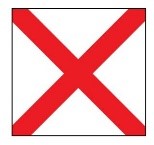 | 1 long sound when displayed | Monitor communication channel for safety instructions (see rule 37). |
| Preparatory | ||
P | 1 when displayed, 1 long when removed | Preparatory signal. |
I | 1 when displayed, 1 long when removed | Rule 30.1 is in effect. |
Z | 1 when displayed, 1 long when removed | Rule 30.2 is in effect. |
U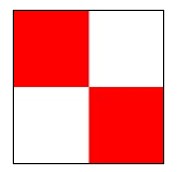 | 1 when displayed, 1 long when removed | Rule 30.3 is in effect. |
Black flag | 1 when displayed, 1 long when removed | Rule 30.4 is in effect. |
| Recall | ||
X | 1 when displayed | Individual recall. |
First Substitute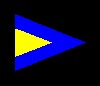 | 2 when displayed, 1 when removed | General recall. The warning signal will be made 1 minute after removal. |
| Shortened Course | ||
S | 2 when displayed | The course has been shortened. Rule 32.2 is in effect. |
| Changing the Next Leg | ||
C | Repetitive | The position of the next mark has been changed: |
C with a green triangle  | Repetitive (with C) | to starboard; |
C with a red rectangle  | Repetitive (with C) | to port; |
C with “–”  | Repetitive (with C) | to decrease the length of the leg; |
C with “+” 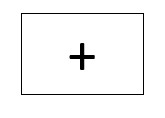 | Repetitive (with C) | to increase the length of the leg. |
| Other | ||
L | 1 when displayed | Ashore: A notice to competitors has been posted. Afloat: Come within hail or follow this vessel. |
M | Repetitive | The object displaying this signal replaces a missing mark. |
Y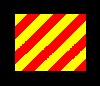 | 1 when displayed | Wear a personal flotation device (see rule 40). |
Orange flag | No sound | The staff displaying this flag is one end of the starting line. |
Blue flag | No sound | The staff displaying this flag is one end of the finishing line. |
Source: World Sailing, Racing Rules of Sailing 2025-2028 (Study Version), Race Signals. Read them online at racingrulesofsailing.org.
Key Points
- A signal displayed over a class flag applies only to that class. Watch for your class flag.
- For starting signals, time is taken from the visual signals; “the absence of a sound signal shall be disregarded” (rule 26).
- I, Z, U and the black flag are displayed at the preparatory signal instead of P. See Conduct of a Race for the starting penalties.
- AP and N each have an “over H” (further signals ashore) and an “over A” (no more racing today) version. AP is for races not started; N is for races in progress.
Race Signals Quiz
For each signal, decide what it means and how many sounds go with it. Then reveal the answer to check your thinking.
#1 – Flag X
What does flag X mean, and how many sounds?
Individual recall, with one sound when it is displayed. At least one boat was on the course side at her starting signal, or must comply with rule 30.1.
#2 – First Substitute
What does the First Substitute mean, and how many sounds?
General recall. “The warning signal will be made 1 minute after removal.” Two sounds when displayed, one when removed.
#3 – AP
What does AP mean, and how many sounds?
Postponement. “Races not started are postponed. The warning signal will be made 1 minute after removal unless at that time the race is postponed again or abandoned.” Two sounds when displayed, one when removed.
#4 – N
What does N mean, and how many sounds?
Abandonment. “All races in progress are abandoned. Return to the starting area. The warning signal will be made 1 minute after removal unless at that time the race is abandoned again or postponed.” Three sounds when displayed, one when removed.
#5 – AP over A vs. N over A
What is the difference between AP over A and N over A?
Both mean no more racing today. AP over A postpones races not started (two sounds). N over A abandons all races in progress (three sounds). Over H instead of A means “Further signals ashore.”
#6 – I, Z, U and Black Flag
When are I, Z, U and the black flag displayed, and what sounds go with them?
They are displayed at the preparatory signal with one sound and removed at the one-minute signal with one long sound. I means rule 30.1 is in effect, Z rule 30.2, U rule 30.3, and the black flag rule 30.4. See Conduct of a Race for what each rule requires.
#7 – Flag S
What does flag S mean, and how many sounds?
Shortened course. “The course has been shortened. Rule 32.2 is in effect.” Two sounds when displayed.
#8 – Flag C and Shapes
What does flag C mean with a green triangle, a red rectangle, “–” and “+”?
Flag C (with repetitive sounds) means “The position of the next mark has been changed.” Green triangle: to starboard. Red rectangle: to port. “–”: to decrease the length of the leg. “+”: to increase the length of the leg.
#9 – L, M, Y and V
What do flags L, M, Y and V mean?
L: “Ashore: A notice to competitors has been posted. Afloat: Come within hail or follow this vessel.” (one sound)
M: “The object displaying this signal replaces a missing mark.” (repetitive sounds)
Y: “Wear a personal flotation device (see rule 40).” (one sound)
V: “Monitor communication channel for safety instructions (see rule 37).” (one long sound)
#10 – Orange and Blue Flags
What do the orange and blue flags mean?
Orange flag: “The staff displaying this flag is one end of the starting line.” Blue flag: “The staff displaying this flag is one end of the finishing line.” Neither has a sound.
Summary
Know the preparatory flags (P, I, Z, U, black), the recall flags (X, First Substitute), and the difference between AP (races not started) and N (races in progress). Listen for the sounds, but go by the flags.
Related Content
- Conduct of a Race
- Racing Terms: Glossary for Newer Sailors
- Race Signals, Racing Rules of Sailing 2025-2028 – racingrulesofsailing.org
- World Sailing Racing Rules of Sailing – World Sailing
