This post has been updated for the 2025-2028 Racing Rules of Sailing.
Restarting after an early start, spinning a penalty turn, a capsized boat in your path: Section D covers the situations the right-of-way rules don’t.
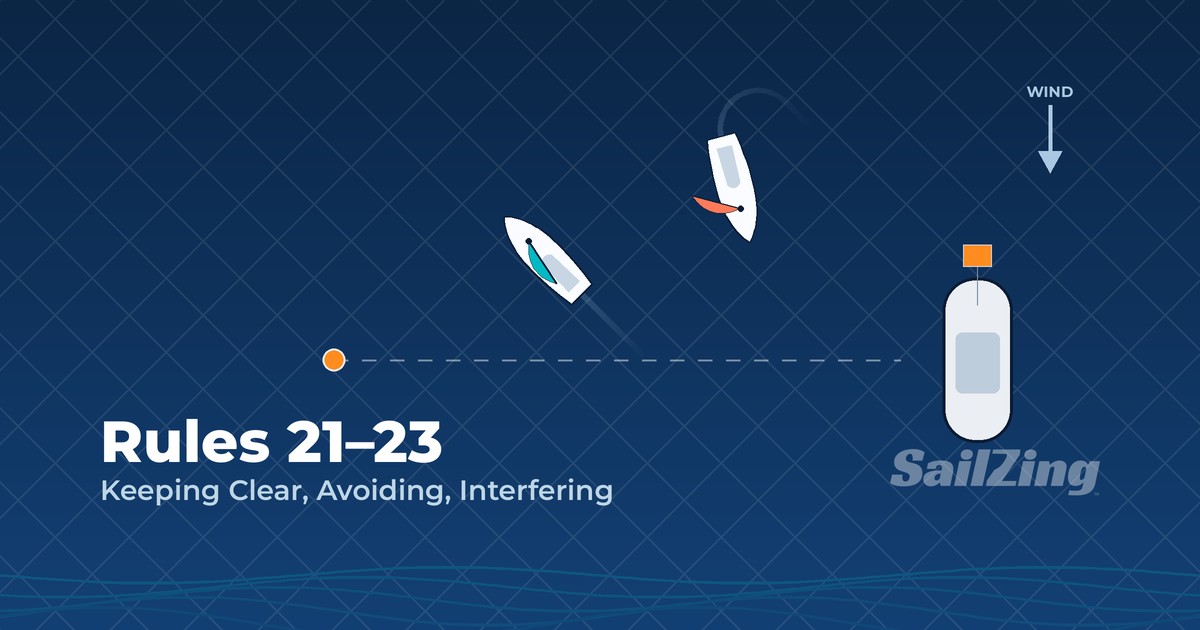
Section D, Other Rules, is the final section of Part 2, When Boats Meet, of the Racing Rules of Sailing (RRS). It contains Rules 21-23, which cover topics that don’t fit neatly into Sections A-C.
In 2018, the Inland Lake Yachting Association (ILYA) and SailZing, LLC partnered on a Fair Sailing initiative. As part of this initiative, SailZing worked with the ILYA and UK Sailmakers to develop a series of articles on the rules. With the rules changes in 2025, SailZing is updating these articles for the 2025-2028 Racing Rules of Sailing.
Section D Preamble
When rule 21 or 22 applies between two boats, Section A rules do not.
Racing Rules of Sailing 2025-2028, Part 2, Section D (World Sailing)
In plain words: when Rule 21 or 22 applies, the usual right-of-way rules (port/starboard, windward/leeward, clear astern, tacking) are switched off between those two boats.
Rule 21 – Starting Errors; Taking Penalties; Backing a Sail
21 STARTING ERRORS; TAKING PENALTIES; BACKING A SAIL
World Sailing, Racing Rules of Sailing 2025-2028 (Study Version). Read Section D online at racingrulesofsailing.org.
21.1 A boat sailing towards the pre-start side of the starting line or one of its extensions after her starting signal to start or to comply with rule 30.1 shall keep clear of a boat not doing so until her hull is completely on the pre-start side.
21.2 A boat taking a penalty shall keep clear of one that is not.
21.3 A boat moving astern, or sideways to windward, through the water by backing a sail shall keep clear of one that is not.


Rule 21 Key Points
- Restarting (21.1): after the starting signal, a boat returning to the pre-start side to start (or to comply with rule 30.1) must keep clear of boats that aren’t, until her hull is completely on the pre-start side.
- Taking a penalty (21.2): a boat doing penalty turns must keep clear of boats that aren’t.
- Backing a sail (21.3): a boat moving astern, or sideways to windward, by backing a sail must keep clear of boats that aren’t.
- In each case, the Section D preamble switches off the Section A right-of-way rules between the two boats.
Rule 22 – Capsized, Anchored or Aground; Rescuing
22 CAPSIZED, ANCHORED OR AGROUND; RESCUING
Racing Rules of Sailing 2025-2028, Part 2, Section D (World Sailing)
If possible, a boat shall avoid a boat that is capsized or has not regained control after capsizing, is anchored or aground, or is trying to help a person or vessel in danger. A boat is capsized when her masthead is in the water.
Rule 22 Key Points

Don’t get too close to a capsized boat. You never know what might happen. As the picture shows, the situation can change rapidly in heavy air.
Rule 23 – Interfering with Another Boat
23 INTERFERING WITH ANOTHER BOAT
World Sailing, Racing Rules of Sailing 2025-2028 (Study Version). Read Section D online at racingrulesofsailing.org.
23.1 If reasonably possible, a boat not racing shall not interfere with a boat that is racing.
23.2 If reasonably possible, a boat shall not interfere with a boat that is taking a penalty, sailing on another leg or subject to rule 21.1. However, after the starting signal this rule does not apply when the boat is sailing her proper course.
Rule 23 Key Points
This rule is about common courtesy. If you are not racing, stay clear of boats that are racing. Some examples:
- When multiple fleets are sailing the same course, fleets that are not in their starting sequence should stay well clear of the starting area.
- After finishing, sail well outside the laylines to the finishing line.
Rule 23.2 may seem to conflict with Rule 21, which requires boats taking a penalty or restarting to keep clear. However, note the last sentence in rule 23.2. After the start, you can’t deviate from your proper course to interfere with boats restarting, taking penalties, or on another leg. If you’re sailing your proper course, you don’t have to worry about interfering with these boats.
Definitions
Racing. A boat is racing from her preparatory signal until she finishes and clears the finishing line and marks or retires, or until the race committee signals a general recall, postponement or abandonment.
Proper Course. A course a boat would choose in order to sail the course as quickly as possible in the absence of the other boats referred to in the rule using the term. A boat has no proper course before her starting signal.
Keep Clear. A boat keeps clear of a right-of-way boat
(a) if the right-of-way boat can sail her course with no need to take avoiding action and,
(b) when the boats are overlapped, if the right-of-way boat can also change course in both directions without immediately making contact.
Rules 21-23 Insights
Various cases in the World Sailing Case Book add insights to these rules. Click the links to read more.
- Case 126: For the purpose of determining whether rule 23.2 applies to an incident, a boat is sailing on the leg which is consistent with her course immediately before the incident and her reasons for sailing that course.
- Case 127: A boat clears the finishing line and marks when no part of her hull, crew or equipment is on the line, and no mark is influencing her choice of course.
Summary
If you remember one thing, make it this: if you’re restarting, doing penalty turns, or backing a sail, you have no rights, so keep clear. Steer well clear of capsized, anchored or aground boats and rescues. And once you’re not racing, stay out of the way of boats that are.
Back to the start of Section C: Rule 18.1 – When Mark-Room Applies. Or review Rules 19-20 – Room at Obstructions.
Related Content
- Rule 10 – On Opposite Tacks
- Rule 14 and Rule 15 – Avoiding Contact and Acquiring Right of Way
- Rules 19-20 – Room at Obstructions
- Racing Terms: Glossary for Newer Sailors
- ILYA #FairSailing Initiative
- Racing Rules of Sailing 2025-2028, Part 2, Section D – Other Rules – World Sailing (official rule text)
- World Sailing Racing Rules of Sailing – World Sailing