This post has been updated for the 2025-2028 Racing Rules of Sailing.
You have right of way, so you can just hold your course and let the other boat worry about it, right? Not quite.
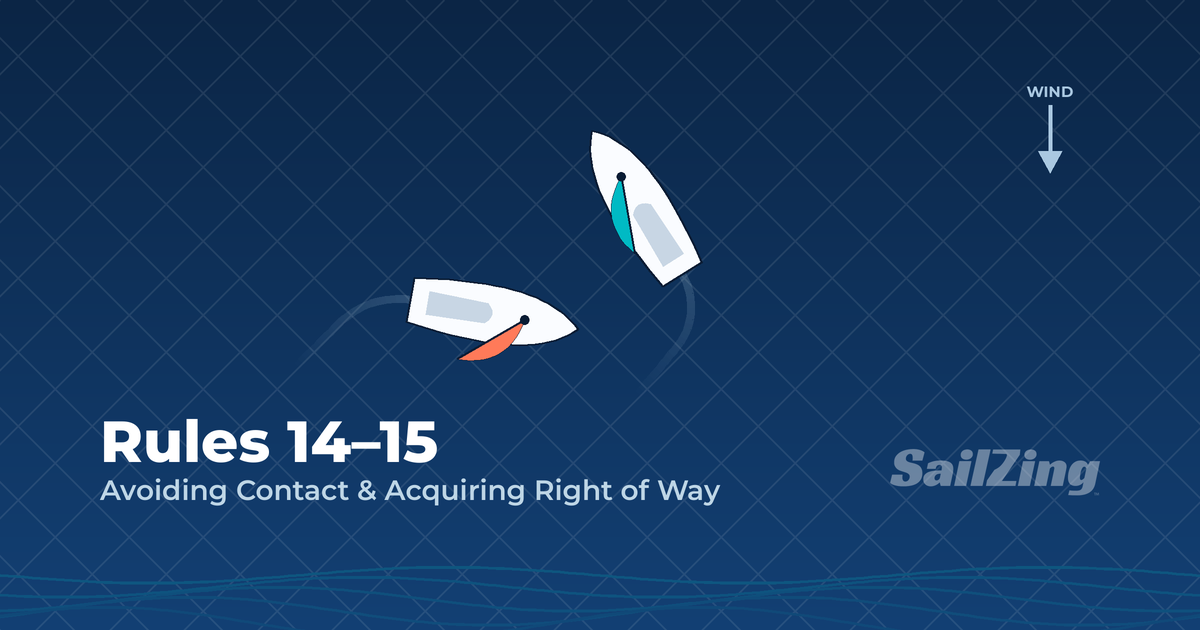
Now that we’ve mastered the right of way rules, we need to learn the limitations on right-of-way boats. Rule 14 and Rule 15 are the first two rules in Part 2, Section B. Rule 14 is Avoiding Contact and Rule 15 is Acquiring Right of Way.
In 2018, the Inland Lake Yachting Association (ILYA) and SailZing, LLC partnered on a Fair Sailing initiative. As part of this initiative, SailZing worked with the ILYA and UK Sailmakers to develop a series of articles on the rules. With the rules changes in 2025, SailZing is updating these articles for the 2025-2028 Racing Rules of Sailing.
Our thanks to UK Sailmakers for generating the animated scenarios.
Part 2, Section B – General Limitations
Congratulations! If you’ve been following along, you’ve now mastered the rules of Part 2, Section A – Right of Way. Remember, the rules in Section A (Rules 10-13) determine right of way when two or more boats meet.
Having right of way doesn’t give you a blank check to affect other boats. The rules of Part 2, Section B – General Limitations – don’t change right of way, but they do limit the actions of right-of-way boats. We’ll cover Rule 14 and Rule 15 in this article.
Rule 14 – Avoiding Contact
14 AVOIDING CONTACT
Racing Rules of Sailing 2025-2028, Part 2, Section B (World Sailing)
If reasonably possible, a boat shall
(a) avoid contact with another boat,
(b) not cause contact between boats, and
(c) not cause contact between a boat and an object that should be avoided.
However, a right-of-way boat, or one sailing within the room or mark-room to which she is entitled, need not act to avoid contact until it is clear that the other boat is not keeping clear or giving room or mark-room.
What Rule 14 Means in Plain Words
- It applies to every boat. Right of way or not, you must avoid hitting another boat if you reasonably can. That’s part (a).
- Don’t cause a collision you aren’t part of. Part (b) says you must not cause contact between boats. Say you squeeze a boat until her only escape is into a third boat. You may break Rule 14 even though your own hull never touched anyone.
- Don’t push a boat into things. Part (c) says you must not cause a boat to hit “an object that should be avoided.” The rulebook doesn’t give a list. Dave Perry, in A Quick Overview of the Significant Rule and Game Changes (US Sailing, January 2025), gives a race committee vessel as an example.
- The right-of-way boat may wait, but not forever. If you have right of way, or you’re sailing within the room or mark-room you’re entitled to, you may hold your course at first. Once it’s clear the other boat isn’t keeping clear or giving you the room or mark-room you’re entitled to, you must act to avoid contact if you reasonably can.
- “Reasonably possible” matters. You aren’t expected to do something dangerous, like a crash gybe (a sudden, uncontrolled gybe), to avoid contact (see Case 99 below).
Definitions
Room. The space a boat needs in the existing conditions, including space to comply with her obligations under the rules of Part 2 and rule 31, while manoeuvring promptly in a seamanlike way.
Mark-Room. Room for a boat
(a) to sail to the mark when her proper course is to sail close to it,
(b) to round or pass the mark on the required side, and
(c) to leave it astern.
Previously-defined term (click to refresh your memory): Keep clear
Rule 14 Key Points
- This rule recognizes that preventing damage or injury is more important than preserving right of way.
- If you are a right-of-way boat and need to act to avoid contact, you assert your rights by protesting the other boat, not by letting contact occur.
- If you are a right-of-way boat or sailing within the room or mark-room to which you are entitled, you don’t need to react until it is clear that the other boat is not keeping clear or giving you room or mark-room.
- However, if there is any damage or injury, no matter how slight, she will be penalized. That applies to the right-of-way boat, or one sailing within the room or mark-room she’s entitled to, if it was reasonably possible to avoid the contact.
- The flip side is rule 43.1(c): “A right-of-way boat, or one sailing within the room or mark-room to which she is entitled, is exonerated for breaking rule 14 if the contact does not cause damage or injury.” (Exonerated means excused, with no penalty.) (RRS Part 4)
- New for 2025-2028: avoiding contact is no longer only about your own boat. You must also, if reasonably possible, not cause contact between other boats, or between a boat and an object that should be avoided.
Rule 14 Changes
For 2025-2028, rule 14 was expanded. In addition to avoiding contact with another boat, a boat must, if reasonably possible, not cause contact between other boats. She also must not cause contact between a boat and an object that should be avoided.
Why the Change?
Optional reading. Skip ahead to Rule 14 Insights if you like.
Rule 14. The new wording came from Submission 012-23, made by the Chair of the World Sailing Racing Rules Committee. It was approved as written, apart from keeping two commas for readability. The submission gave two reasons:
- The old rule 14 only talked about contact with another boat. The rule should also require boats not to cause contact.
- This wording was already in use without problems: in the America’s Cup since 2019, in the High Speed Rules since 2020, and in Appendix UF since 2021. In the submission’s words, “There have been no negative experiences with racing using this rule.”
Mark-Room (a term used in Rule 14). The definition was rewritten in Submission 013-23, also from the Chair of the Racing Rules Committee. World Sailing approved it “as edited.” These are the submission’s reasons that match the final wording:
- Adding “to leave it astern” settles the long debate about when a boat has been given mark-room.
- Dropping “without touching the mark” removes a phrase the submission called unnecessary. The definition Room already includes space to comply with rule 31 (touching a mark) and to manoeuvre in a seamanlike way.
- Deleting the old last sentence about room to tack settles a debate among rules experts. The question was whether a boat is entitled to complete a tack after rule 18 stops applying.
Rule 15. World Sailing made no change to Rule 15 for 2025-2028.
Sources: World Sailing, 2023 Submissions (012-23 and 013-23); World Sailing, Study Version of the RRS 2025-2028 (change comments).
Rule 14 Insights
Various cases in the World Sailing Case Book add insights to this rule. Click the links to read more.
- Case 26: Not watching for other boats is no excuse for failing to avoid contact. A right-of-way boat need not act until it is clear that the other boat isn’t keeping clear. But if she could then have avoided a collision that causes damage, she must be penalized under Rule 14.
- Case 50: In a port-starboard incident with no contact, the starboard-tack boat (S) doesn’t have to hold her course and hit the port-tack boat (P) to prove a collision was coming. If she did, she would break Rule 14. P must keep clear (Rule 10), which means S must be able to sail her course with no need to take avoiding action. If S changed course and there was reasonable doubt that P could have crossed ahead, P should be disqualified. If S didn’t change course and had no genuine and reasonable apprehension of collision, the protest committee should dismiss her protest.
- Case 99: The right-of-way boat is not required to take extreme measures (such as a crash gybe that might cause damage in itself) to avoid a collision.
Rule 15 – Acquiring Right of Way
15 ACQUIRING RIGHT OF WAY
Racing Rules of Sailing 2025-2028, Part 2, Section B (World Sailing)
When a boat acquires right of way, she shall initially give the other boat room to keep clear, unless she acquires right of way because of the other boat’s actions.
There were no changes to Rule 15 for 2025-2028.
What Rule 15 Means in Plain Words
- “Acquires right of way” means the moment you become the right-of-way boat. A common example is when a boat clear astern sails into a leeward overlap, as in Scenario #3 below.
- “Initially” means right at that moment. The other boat suddenly has to keep clear, so you must give her enough space to do it. That means space to respond promptly in a seamanlike way.
- The exception: If you gained right of way because of the other boat’s actions, Rule 15 doesn’t require you to give her that room. For example, if a nearby boat tacks and that hands you right of way, you owe her nothing extra under Rule 15.
Rule 15 Scenarios
For each scenario, read the description, watch the animation, and choose your answer. Then reveal the answer to check your thinking.
#1 – “Small Hole on the Starting Line”
Description: Green approaches the starting line and sails between Blue and Yellow. Green expects Yellow to keep clear as the windward boat. There is no contact.

Which boat(s) should promptly take a penalty?
Green should take a penalty. Green broke Rule 11 by not keeping clear of Blue (the right-of-way boat), since Blue could not change course in both directions without immediately making contact. When she acquired right of way over Yellow, Green also broke Rule 15, by not initially giving Yellow room to keep clear, since Yellow could not head up without contacting Green.
#2 – “Tacking too Close”
Description: Yellow and Blue are sailing upwind. Yellow hails “tacking” and immediately tacks, causing contact. Yellow alleges she gave Blue plenty of warning by hailing.

Which boat(s) should promptly take a penalty?
Yellow should take a penalty. Yellow passed head to wind but did not reach a close-hauled course until just before contact at position 3. Until then, Rule 13 (While Tacking) required her to keep clear of Blue. Once she was close-hauled on starboard tack, Rule 15 required her to initially give Blue room to keep clear, and she didn’t. Yellow could easily have avoided the contact by not tacking, so she also broke Rule 14. The rules do not recognize hailing as a way to avoid giving room to keep clear.
#3 – “What does ‘Initially’ Mean?”
Description: Yellow and Blue are sailing downwind. Blue acquires an overlap at position 2 and Yellow protests immediately.

Which boat(s) should promptly take a penalty?
Blue should take a penalty. Blue broke Rule 15 by not initially giving Yellow room to keep clear, since Yellow could not head up to avoid Blue without making contact. In this case, Yellow’s protest indicates that Yellow did not initially have room to keep clear. Note, however, that if Yellow had delayed her protest until later, a protest committee might dismiss the protest, reasoning that Yellow’s delay indicated she initially felt she had enough room.
Summary
If you remember one thing, make it this: right of way is not a blank check. Rule 14 says avoid contact if you reasonably can, and don’t cause it between other boats either. Rule 15 says that when you become the right-of-way boat, give the other boat room to keep clear at first.
When someone fouls you, protest. Don’t “take” your rights with a collision.
Rule 16 – Changing Course comes next.
Related Content
- Rule 10 – On Opposite Tacks
- Rule 16 – Changing Course
- Rule 18.1 – When Mark-Room Applies
- Rule 18.2 – Giving Mark-Room
- Racing Terms: Glossary for Newer Sailors
- ILYA #FairSailing Initiative
- Racing Rules of Sailing 2025-2028, Part 2 – When Boats Meet – World Sailing (official rule text)
- World Sailing Racing Rules of Sailing – World Sailing