This post has been updated for the 2025-2028 Racing Rules of Sailing.
You tack onto starboard inside the zone at the windward mark. Who do you have to look out for? Under the 2025 rules, it comes down to one question: is the starboard boat fetching the mark?
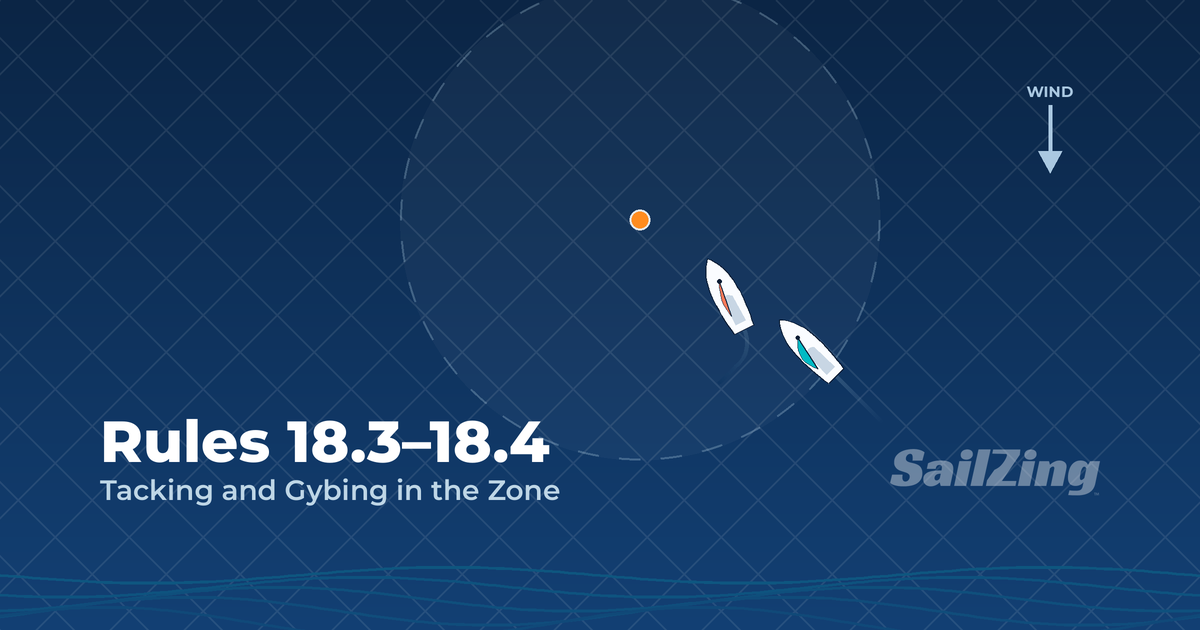
Our third article on Rule 18 – Mark-Room covers Rule 18.3 – Tacking in the Zone and Rule 18.4 – Gybing in the Zone. They follow Rule 18.1 – When Mark-Room Applies and Rule 18.2 – Giving Mark-Room.
In 2018, the Inland Lake Yachting Association (ILYA) and SailZing, LLC partnered on a Fair Sailing initiative. As part of this initiative, SailZing worked with the ILYA and UK Sailmakers to develop a series of articles on the rules. With the rules changes in 2025, SailZing is updating these articles for the 2025-2028 Racing Rules of Sailing.
Our thanks to UK Sailmakers for generating the animated scenarios.
Rule 18.3 – Tacking in the Zone
18.3 Tacking in the Zone
Racing Rules of Sailing 2025-2028, Part 2, Section C (World Sailing)
If a boat passes head to wind from port to starboard tack in the zone of a mark to be left to port, rule 18.2 does not apply between her and another boat on starboard tack that is fetching the mark. If the other boat has been on starboard tack since entering the zone, the boat that passed head to wind
(a) shall not cause the other boat to sail above close-hauled to avoid contact, and
(b) shall give mark-room if the other boat becomes overlapped inside her.
What Rule 18.3 Means in Plain Words
- When it applies: a boat tacks from port to starboard inside the zone (three hull lengths) of a mark you leave to port, usually the windward mark, near another starboard-tack boat that is fetching the mark (she can get around it without tacking).
- What it switches off: Rule 18.2 doesn’t apply between those two boats, so the boat that tacked can’t claim mark-room from the starboard boat under 18.2.
- Extra limits on the boat that tacked, if the starboard boat has been on starboard since entering the zone: (a) she must not make the starboard boat sail above close-hauled to avoid contact, and (b) she must give mark-room if the starboard boat gets overlapped inside her.
- What doesn’t matter: whether the boat that tacked is fetching after her tack. The test is about the other boat.
- The other rules still apply. While she is tacking, the boat that tacked must keep clear under Rule 13.
Definitions
Fetching. A boat is fetching a mark when she is in a position to pass to windward of it and leave it on the required side without changing tack.
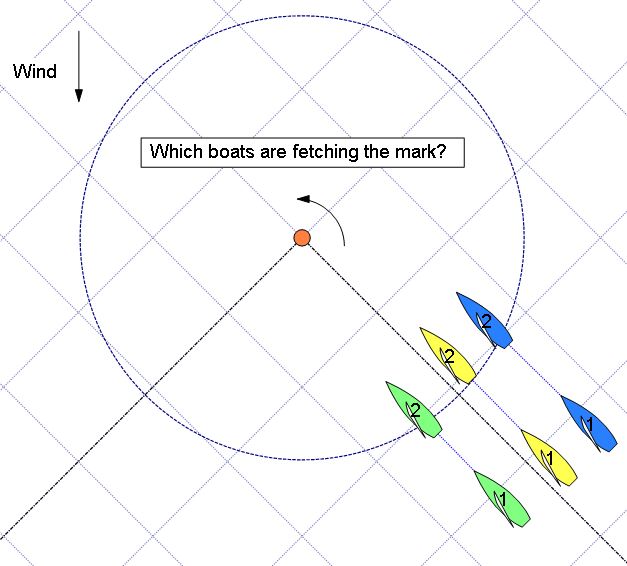
Blue and Yellow are fetching the mark.
Mark. An object the sailing instructions require a boat to leave on a specified side, a race committee vessel surrounded by navigable water from which the starting or finishing line extends, and an object intentionally attached to the object or vessel. However, an anchor line is not part of the mark.
Zone. The area around a mark within a distance of three hull lengths of the boat nearer to it. A boat is in the zone when any part of her hull is in the zone.
Mark-Room. Room for a boat
(a) to sail to the mark when her proper course is to sail close to it,
(b) to round or pass the mark on the required side, and
(c) to leave it astern.
Tack, Starboard or Port. A boat is on the tack, starboard or port, corresponding to her windward side.
Rule 18.3 Key Points
- 18.3 applies only if the starboard boat you tack near is fetching the mark. It doesn’t matter whether you are fetching after your tack.
- If you tack inside another starboard boat that is fetching, you get no mark-room from her under 18.2, even if she also tacked in the zone.
- If you tack from port to starboard in the zone, you can’t cause a fetching boat that has been on starboard since entering the zone to sail above close-hauled. This is true even if you complete your tack clear ahead of her.
- If such a boat becomes overlapped inside you, you must give her mark-room.
Rule 18.3 and 18.4 Changes
For 2025-2028, Rule 18.3 was rewritten and renamed “Tacking in the Zone” (it was “Passing Head to Wind in the Zone” in 2021-2024). The old rule applied when the boat that tacked was then fetching. The new rule turns on whether the other starboard boat is fetching. Rule 18.4 was renamed “Gybing in the Zone”; its text is unchanged.
Why the Change?
Optional reading. Skip ahead to the Rule 18.3 Scenarios if you like.
Rule 18.3. The Study Version of the 2025-2028 rules ties the new Rule 18.3 to Submission E07-24. The effect: 18.2 is switched off between the boat that tacked and any starboard boat that is fetching the mark, and the 18.3(a) and (b) limits now depend on the starboard boat, not on whether the boat that tacked is fetching.
Rule 18.4 title. The new title came from Submission 013-23, Proposal 10. The submission’s reason: “The title parallels the title of proposed rule 18.3 … which helps make the rules easier to read, understand and remember for the sailors and race officials.”
Sources: World Sailing, 2023 Submissions; World Sailing, Study Version of the RRS 2025-2028 (change comments).
Rule 18.3 Scenarios
For each scenario, read the description, watch the animation, and choose your answer. Then reveal the answer to check your thinking.
#1 – “Tacking in the Zone, Example 1”
Description: Yellow and Blue are inside the zone sailing to the windward mark. Yellow has been on starboard since entering the zone and is fetching the mark. Blue tacks to starboard and pinches up to round the mark. Yellow heads up above close-hauled to avoid Blue. There is no contact.
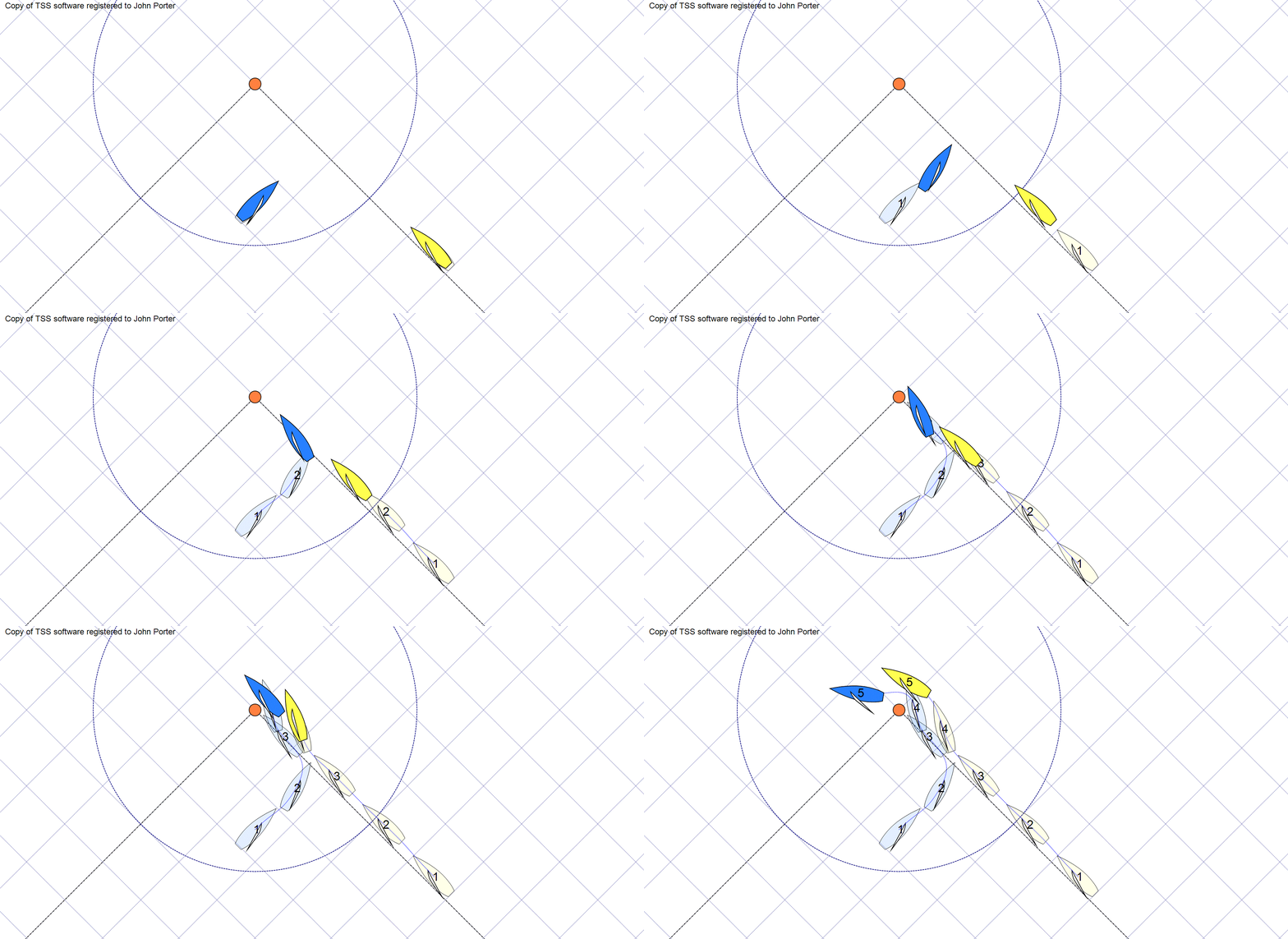
Which boat(s) should promptly take a penalty?
Blue should promptly take a penalty. Yellow had been on starboard since entering the zone and was fetching the mark (she was sailing along the starboard layline). Blue passed head to wind from port to starboard in the zone, so rule 18.3 applies between them. Blue caused Yellow to sail above close-hauled to avoid contact, so Blue broke Rule 18.3(a). Whether Blue herself was fetching after her tack doesn’t matter.
What should Blue have done in this situation?
Blue can either cross ahead of Yellow or duck behind Yellow before tacking.
#2 – “Tacking in the Zone, Example 2”
Description: Yellow and Blue are inside the zone sailing to the windward mark. Blue crosses Yellow and then tacks to starboard.
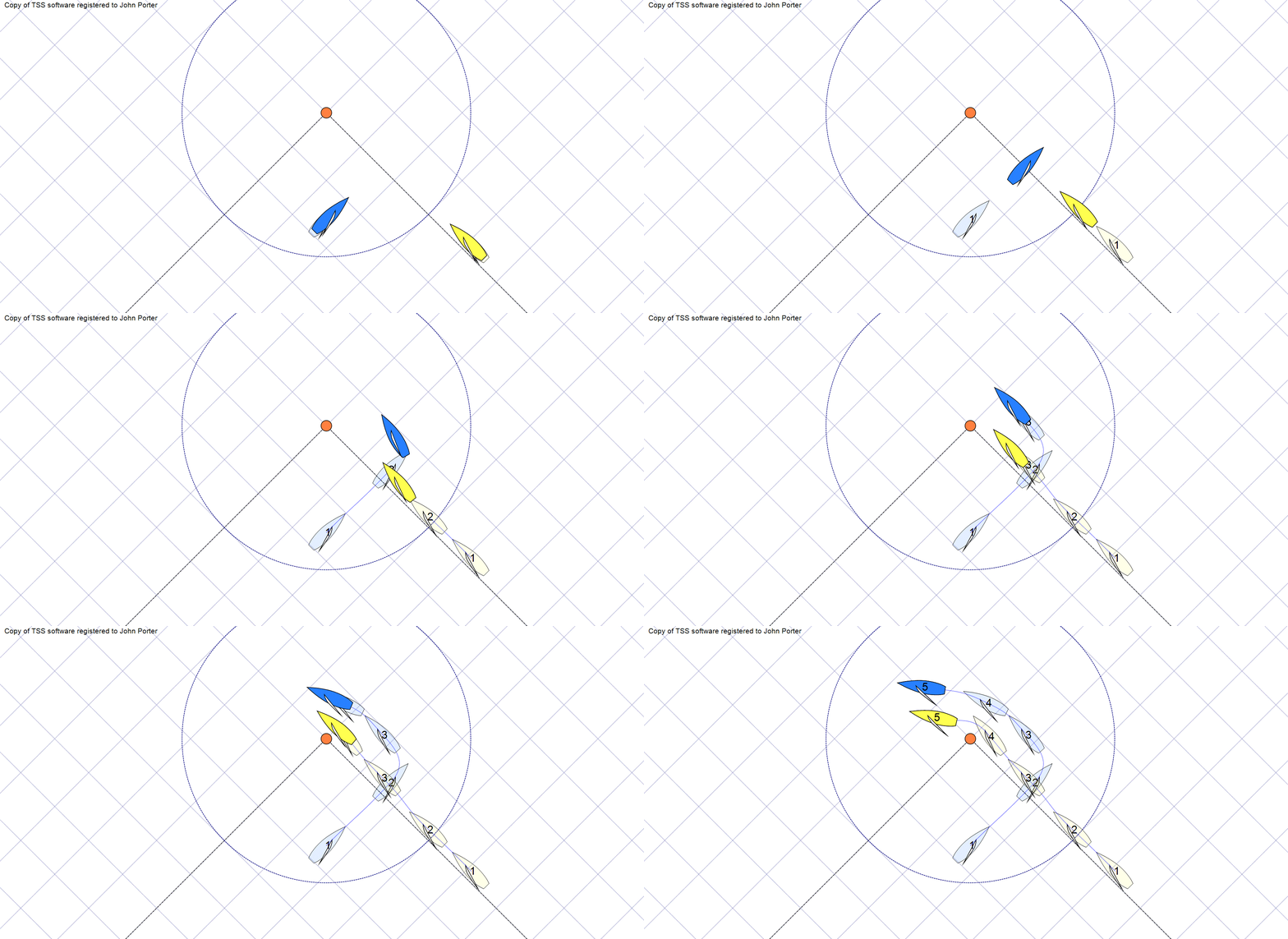
Which boat(s) should promptly take a penalty?
Neither boat. Blue is able to cross ahead of Yellow on port while keeping clear. rule 18.3 applies after Blue tacks to starboard, and Yellow becomes overlapped inside Blue. Blue gave Yellow mark-room, as required by Rule 18.3(b).
#3 – “Tacking in the Zone, Example 3”
Description: Yellow and Blue are inside the zone sailing to the windward mark. Yellow is reaching into the mark. Blue tacks to starboard and rounds the mark. Yellow heads up to close-hauled to avoid Blue. There is no contact.
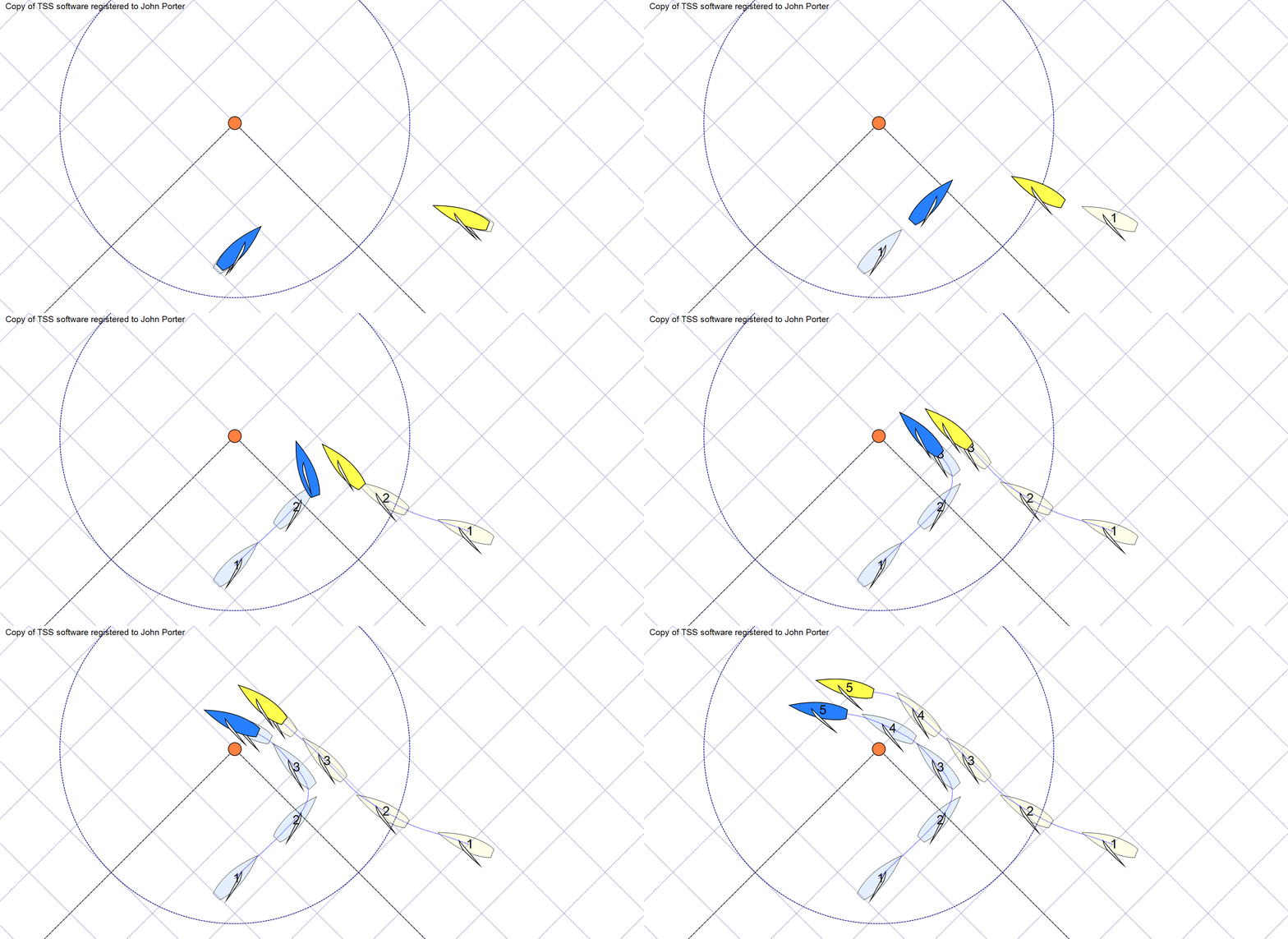
Which boat(s) should promptly take a penalty?
Neither boat. Blue tacks to starboard within the zone, and Yellow, reaching into the mark, is fetching it, so rule 18.3 applies. However, Blue did not cause Yellow to sail above close-hauled to avoid contact, since Yellow was reaching into the mark and only had to head up to close-hauled.
Rule 18.4 – Gybing in the Zone
18.4 Gybing in the Zone
World Sailing, Racing Rules of Sailing 2025-2028 (Study Version). Read Section C online at racingrulesofsailing.org.
When an inside overlapped right-of-way boat must gybe at a mark to sail her proper course, until she gybes she shall sail no farther from the mark than needed to sail that course. Rule 18.4 does not apply at a gate mark.
What Rule 18.4 Means in Plain Words
- Who it limits: an inside overlapped right-of-way boat that has to gybe at a mark to sail her proper course, typically at a leeward mark.
- What it limits: until she gybes, she can’t sail farther from the mark than she needs to. She can’t carry the outside boat past the mark to slow her down.
- Not at a gate: at a gate, a right-of-way boat may choose either gate mark, so 18.4 doesn’t apply.
Definitions
Clear Astern and Clear Ahead; Overlap. One boat is clear astern of another when her hull and equipment in normal position are behind a line abeam from the aftermost point of the other boat’s hull and equipment in normal position. The other boat is clear ahead. They overlap when neither is clear astern. However, they also overlap when a boat between them overlaps both. These terms always apply to boats on the same tack. They apply to boats on opposite tacks only when rule 18 applies between them or when both boats are sailing more than ninety degrees from the true wind.
Proper Course. A course a boat would choose in order to sail the course as quickly as possible in the absence of the other boats referred to in the rule using the term. A boat has no proper course before her starting signal.
Rule 18.4 Scenarios
For each scenario, read the description, watch the animation, and choose your answer. Then reveal the answer to check your thinking.
#4 – “Gybing in the Zone”
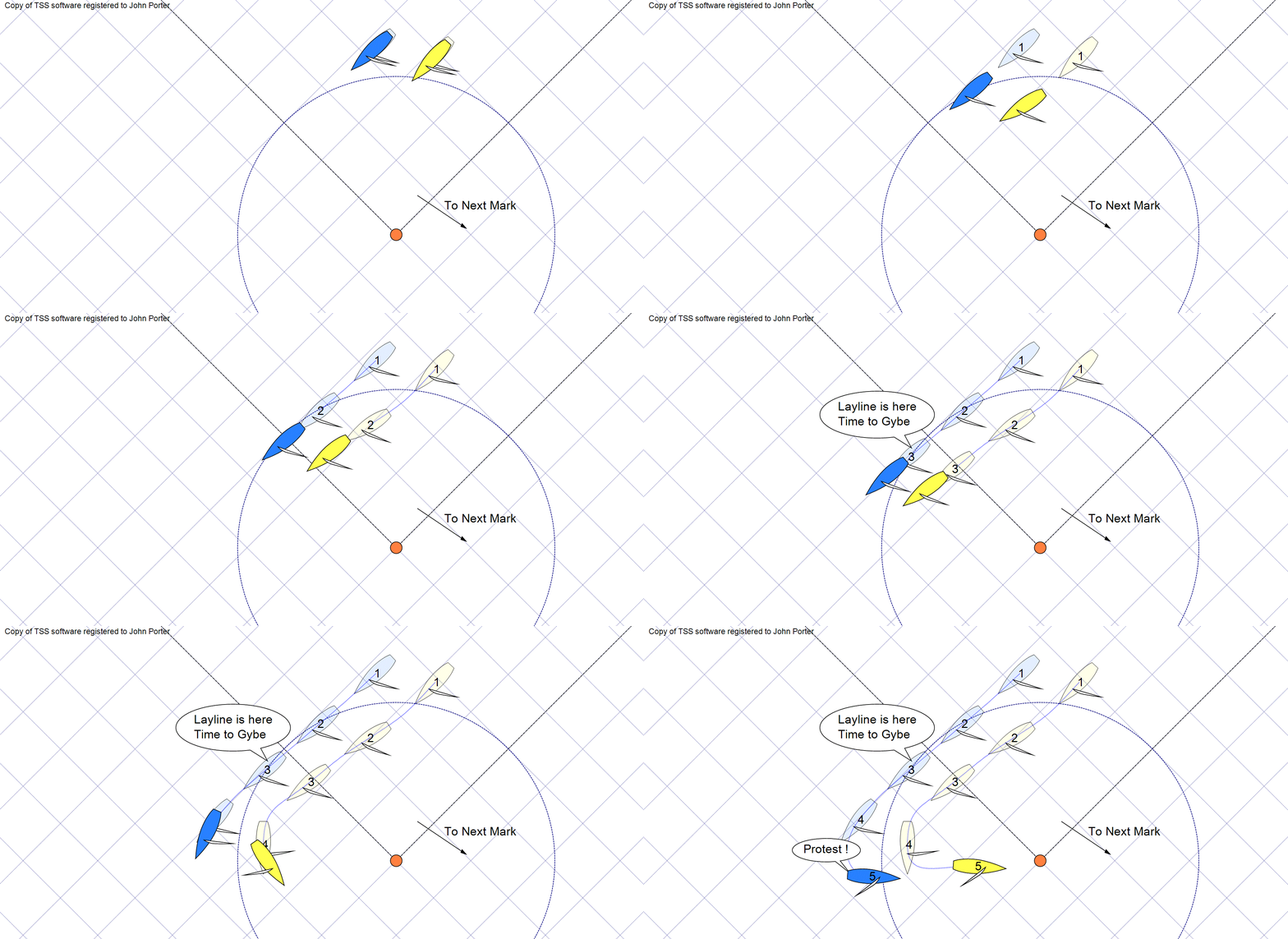
Description: Yellow and Blue are sailing toward a mark. Note the direction of the next mark. When Yellow enters the zone, Blue is overlapped. Yellow sails the course shown. Blue protests Yellow.
Which boat(s) should promptly take a penalty?
Yellow should promptly take a penalty. Yellow was the inside overlapped right-of-way boat and needed to gybe to sail her proper course to the next mark, so rule 18.4 applies. Until she gybes, she must sail no farther from the mark than needed to sail that course. Since Yellow went past the layline (she sailed farther than necessary before gybing), she broke Rule 18.4.
#5 – “Why Doesn’t Rule 18.4 Apply at a Gate?”
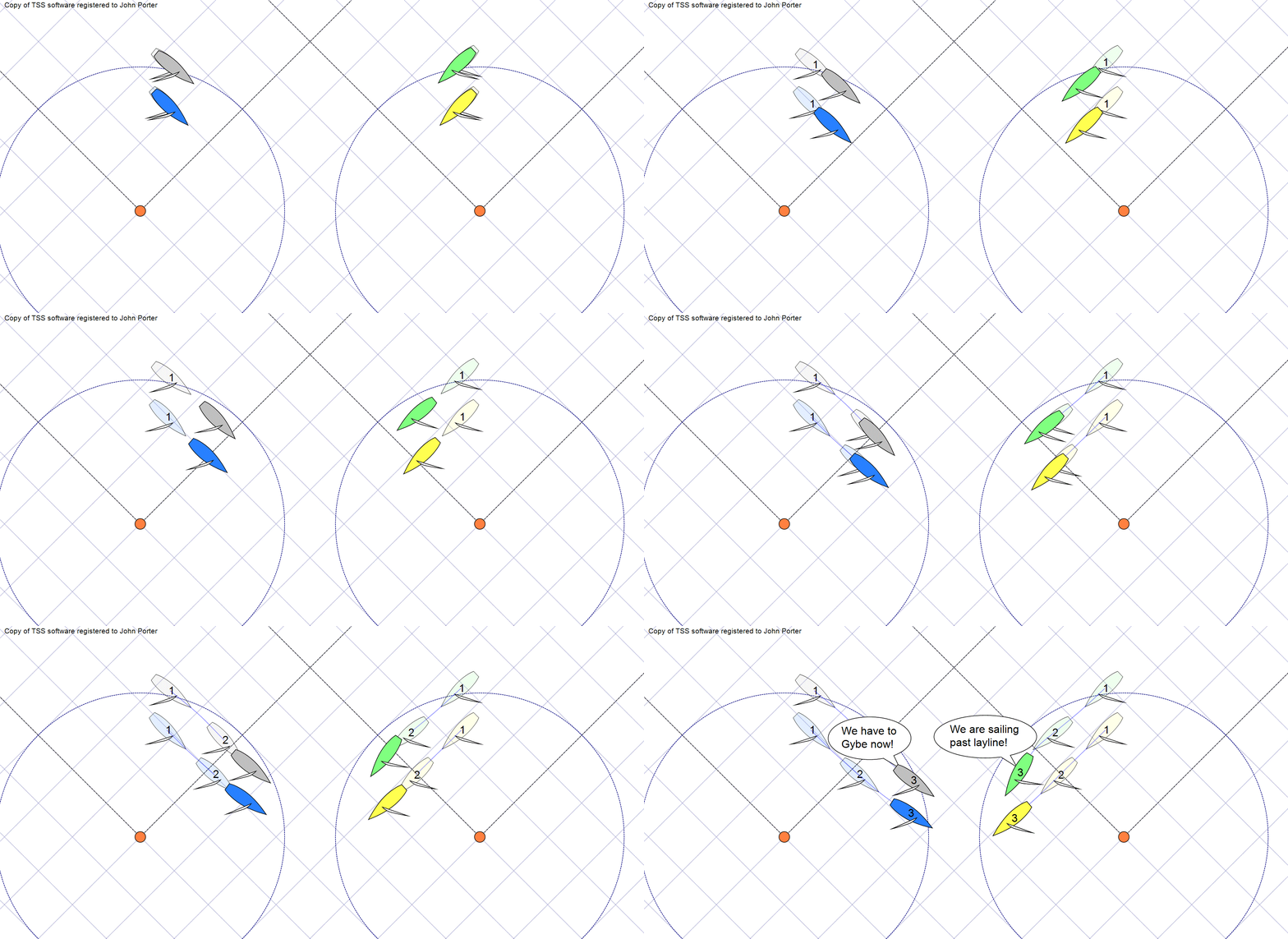
Description: Four boats are sailing downwind towards a gate.
Can Yellow sail to the far gate (the left gate, looking from above), even if Green wants to go to the right gate?
Yes. Yellow can sail to the left gate, since Yellow has right of way (leeward boat) and rule 18.4 does not apply at a gate mark. If Rule 18.4 applied at a gate, Yellow could make it very difficult for Green to choose the right gate, which could give Yellow an unfair advantage.
Can Blue sail to the right gate, even if Grey wants to go to the left gate?
Yes. Blue can sail to the right gate, since Blue has right of way (leeward boat) and Rule 18.4 does not apply at a gate mark.
Can Yellow sail to the left gate, even if Blue wants to go to the right gate?
Yes. Yellow can sail to the left gate, since Yellow has right of way (starboard tack).
Rule 18 Insights
Various cases in the World Sailing Case Book add insights to this rule. Click the link to read more.
- Case 95: When a boat is required to give another boat mark-room, the space she must give includes space for the other boat to comply with rule 31. When the boat entitled to mark-room is compelled to touch the mark while sailing within the mark-room to which she is entitled, she is exonerated for her breach of rule 31.
Summary
If you remember one thing, make it this: before you tack onto starboard in the zone, look for a starboard boat that is fetching the mark. If there is one, you get no mark-room from her, and you mustn’t make her sail above close-hauled. At a leeward mark, an inside right-of-way boat that has to gybe can’t sail past the mark just to carry you wide, unless it’s a gate.
Rules 19-20 – Room at Obstructions comes next.
Related Content
- Rule 14 and Rule 15 – Avoiding Contact and Acquiring Right of Way
- Rule 18.1 – When Mark-Room Applies
- Rule 18.2 – Giving Mark-Room
- Rules 19-20 – Room at Obstructions
- Racing Terms: Glossary for Newer Sailors
- ILYA #FairSailing Initiative
- Racing Rules of Sailing 2025-2028, Part 2, Section C – At Marks and Obstructions – World Sailing (official rule text)
- World Sailing Racing Rules of Sailing – World Sailing