This post has been updated for the 2025-2028 Racing Rules of Sailing.
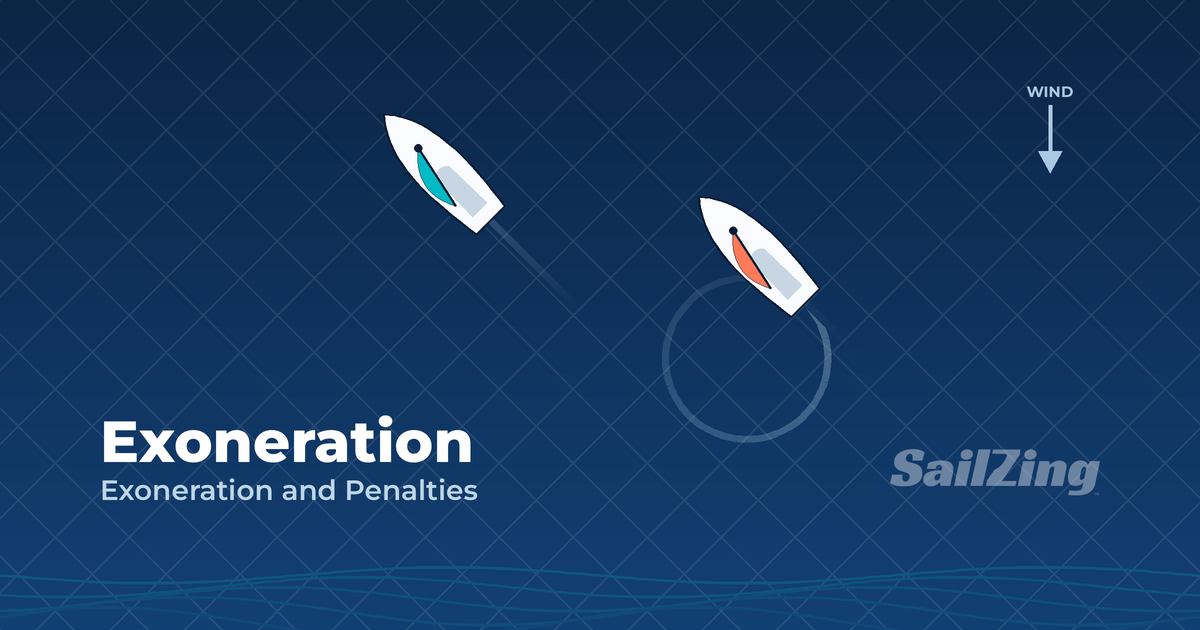
You broke a rule, but only because another boat forced you to. Do you still have to do turns? Rule 43 answers that, and Rule 44 tells you how to take a penalty when you do owe one.
Part 4 (Rules 40-56) of the Racing Rules of Sailing (RRS) covers other requirements when racing. This article covers Rule 43 – Exoneration and Rule 44 – Penalties at the Time of an Incident.
In 2018, the Inland Lake Yachting Association (ILYA) and SailZing, LLC partnered on a Fair Sailing initiative. As part of this initiative, SailZing worked with the ILYA and UK Sailmakers to develop a series of articles on the rules. With the rules changes in 2025, SailZing is updating these articles for the 2025-2028 Racing Rules of Sailing.
Rule 43 – Exoneration
43 EXONERATION
Racing Rules of Sailing 2025-2028, Part 4 (World Sailing)
43.1 (a) When as a consequence of breaking a rule a boat has compelled another boat to break a rule, the other boat is exonerated for her breach.
(b) When a boat is sailing within the room or mark-room to which she is entitled and, as a consequence of an incident with a boat required to give her that room or mark-room, she breaks a rule of Section A of Part 2, rule 15, 16, or 31, she is exonerated for her breach.
(c) A right-of-way boat, or one sailing within the room or mark-room to which she is entitled, is exonerated for breaking rule 14 if the contact does not cause damage or injury.
43.2 A boat exonerated for breaking a rule need not take a penalty and shall not be penalized for breaking that rule.
What Rule 43 Means in Plain Words
- Exonerated means excused: you broke a rule, but you don’t have to take a penalty and can’t be penalized for it. No hearing is needed for that.
- 43.1(a) – forced by another boat’s breach: if another boat broke a rule and that forced you to break one, you are exonerated.
- 43.1(b) – sailing within your room or mark-room: if you’re sailing within the room or mark-room you’re entitled to and, because of an incident with the boat that owes it to you, you break a Section A rule (Rules 10-13), Rule 15, 16 or 31, you are exonerated. This can apply at marks (Rule 18), at obstructions (Rules 19 and 20), and when Rules 15 or 16 require room.
- 43.1(c) – contact without damage: a right-of-way boat, or one sailing within her room or mark-room, is exonerated for breaking Rule 14 (avoiding contact) if the contact causes no damage or injury.
Definitions
Rule. (a) The rules in this book, including the Definitions, Race Signals, Introduction, preambles and the rules of relevant appendices, but not the Basic Principles or titles; (b) World Sailing Regulations that have been designated by World Sailing as having the status of a rule and are published on the World Sailing website; (c) the prescriptions of the national authority, unless they are changed by the sailing instructions in compliance with the national authority’s prescription, if any, to rule 88.2; (d) the class rules (for a boat racing under a handicap or rating system, the rules of that system are ‘class rules’); (e) the notice of race; (f) the sailing instructions; and (g) any other documents that govern the event.
Room. The space a boat needs in the existing conditions, including space to comply with her obligations under the rules of Part 2 and rule 31, while manoeuvring promptly in a seamanlike way.
Mark-Room. Room for a boat
(a) to sail to the mark when her proper course is to sail close to it,
(b) to round or pass the mark on the required side, and
(c) to leave it astern.
Rule 43 Scenarios
For each scenario, read the description, watch the animation, and choose your answer. Then reveal the answer to check your thinking.
#1 – “Mark-Room, Example 1”
Description: Yellow and Blue are sailing to the leeward mark. Blue is clear ahead when reaching the zone. Blue sails wide of the mark but then heads up aggressively to a close-hauled course, forcing Yellow to hit the mark. Yellow protests Blue for breaking Rule 16. Blue protests Yellow for hitting the mark.

Which boat(s) should promptly take a penalty?
Yellow should promptly take a penalty. Blue reached the zone clear ahead, so she was entitled to mark-room under rule 18.2(a)(2), and Rule 43 applies. Blue changed course rapidly, breaking Rule 16, but she is exonerated under rule 43.1(b). Yellow broke Rule 31 (touching a mark). One penalty covers all of Yellow’s breaches in the incident.
#2 – “Mark-Room, Example 2”
Description: Blue is rounding a leeward mark inside Yellow and is entitled to mark-room under rule 18.2(a)(1). Yellow heads up, making contact and forcing Blue to head up and hit the mark.

Which boat(s) should promptly take a penalty?
Yellow should promptly take a penalty. Yellow broke rule 18.2(a)(1) by not giving Blue mark-room. Even though Blue broke Rule 11 (keeping clear of a leeward boat on the same tack) and Rule 31 (touching a mark), Blue does not need to take a penalty, since she is exonerated under rule 43.1(b).
#3 – “Obstruction”
Description: Blue is on port tack with Green to leeward. Blue and Green approach Yellow, a starboard boat, which is an obstruction. Green ducks Yellow but does not appear to be giving Blue room to duck. Blue heads down to duck, forcing Green to head down further. Green protests Blue for breaking rule 11.

Should Blue promptly take a penalty?
No. Green owes Blue room to duck (rule 19.2(b), room to pass the obstruction). Blue broke Rule 11, but she does not need to take a penalty, since she is exonerated under rule 43.1(b).
Green, who didn’t give room, broke rule 19.2(b) and should take a penalty.
Rule 44 – Penalties at the Time of an Incident
44.1 Taking a Penalty
Racing Rules of Sailing 2025-2028, Part 4 (World Sailing)
A boat may take a Two-Turns Penalty when she may have broken one or more rules of Part 2 in an incident while racing. She may take a One-Turn Penalty when she may have broken rule 31. Alternatively, the notice of race or sailing instructions may specify the use of the Scoring Penalty or some other penalty, in which case the specified penalty shall replace the One-Turn and the Two-Turns Penalty. However,
(a) when a boat may have broken a rule of Part 2 and rule 31 in the same incident she need not take the penalty for breaking rule 31;
(b) if the boat caused injury or serious damage or, despite taking a penalty, gained a significant advantage in the race or series by her breach her penalty shall be to retire.
44.2 One-Turn and Two-Turns Penalties
After getting well clear of other boats as soon after the incident as possible, a boat takes a One-Turn or Two-Turns Penalty by promptly making the required number of turns in the same direction, each turn including one tack and one gybe. When a boat takes the penalty at or near the finishing line, her hull shall be completely on the course side of the line before she finishes.
Rule 44.3 – Scoring Penalty. A boat may take a Scoring Penalty (by displaying a yellow flag) only if the notice of race or sailing instructions say so. When the number of points isn’t stated, the penalty is 20% of the score for Did Not Finish, rounded to the nearest tenth of a point (0.05 rounded upward). It’s uncommon, so we won’t cover it in detail here.
Definitions
Finish. A boat finishes when, after her starting signal, any part of her hull crosses the finishing line from the course side. However, she has not finished if after crossing the finishing line she
(a) takes a penalty under rule 44.2,
(b) corrects an error in sailing the course made at the line, or
(c) continues to sail the course.
After finishing she need not cross the finishing line completely. The sailing instructions may change the direction in which boats are required to cross the finishing line to finish.
Rule 44 Key Points
- You may take a One-Turn Penalty for breaking Rule 31 (touching a mark).
- You may take a Two-Turns Penalty for breaking a rule of Part 2.
- Each turn includes one tack and one gybe, in the same direction.
- Get well clear of other boats as soon after the incident as possible, then promptly do your turns.
- If you caused injury or serious damage, or gained a significant advantage despite taking a penalty, your penalty is to retire.
- US Sailing Appendix V (a US prescription) offers alternative penalties, but only if the notice of race or sailing instructions say so. Under V1, a One-Turn Penalty replaces the Two-Turns Penalty for Part 2 breaches, except in the zone around a mark other than a starting mark, where it stays a Two-Turns Penalty. Under V2, a boat may take a 30% Post-Race Penalty, which “does not replace any penalty that may be taken under rule 44.1.” (US Sailing Prescriptions 2025-2028)
Rule 44 Changes
For 2025-2028, Rules 43, 44.1 and 44.2 are unchanged. Rule 44.3 (Scoring Penalty) now applies only if the notice of race or sailing instructions specify it, and the penalty is now counted in points, rounded to the nearest tenth of a point.
Why the Change?
Optional reading. Skip ahead to the Rule 44 Questions if you like.
Rule 44.3(a). The Study Version of the 2025-2028 rules ties the change to Submission 029-21 (as edited). The effect: the Scoring Penalty is available only “if specified in the notice of race or sailing instructions.”
Rule 44.3(c). This change came from Submission 017-23 (as amended), from the Chair of the Racing Rules Committee. Its purpose was “to align the rounding for scoring penalty with rule A9 and the recommendations in the World Sailing Jury Policies for discretionary penalties.”
Sources: World Sailing, Study Version of the RRS 2025-2028 (change comments); World Sailing, 2023 Submissions (017-23).
Rule 44 Questions
Read each question and decide your answer. Then reveal the answer to check your thinking.
#1 – Port-Starboard Without a Hail
While sailing upwind on port tack, you do not see an approaching starboard-tack boat until the last minute. The starboard-tack boat changes course to avoid you. There is no contact. The starboard-tack boat does not hail “Protest.”
What are your actions under the rules?
You should promptly take a Two-Turns Penalty. rule 44.1 says a boat may take a Two-Turns Penalty when she may have broken one or more rules of Part 2 in an incident while racing. The Basic Principle Sportsmanship and the Rules says: “A fundamental principle of sportsmanship is that when a boat breaks a rule and is not exonerated she will promptly take an appropriate penalty or action, which may be to retire.” The other boat doesn’t need to hail for you to owe a penalty.
#2 – One-Turn Penalty at the Windward Mark
When rounding the windward mark, your boat touches the mark. No other boats are nearby. You sail the course shown and continue on.

Have you properly completed a One-Turn Penalty?
Yes. A One-Turn Penalty consists of one tack and one gybe (rule 44.2). Turning a full 360 degrees is not required.
#3 – Penalty Before the Start
Five seconds before the start, your boat makes contact with a leeward boat. The leeward boat hails “Protest.” You sail upwind for about 30 seconds to get clear air and then complete your penalty turns.
Have you properly complied with Rule 44?
No. rule 44.2 requires you to get well clear of other boats as soon after the incident as possible and then promptly take your penalty turns. Sailing for 30 seconds to get clear air does not comply with this requirement.
Summary
If you remember one thing, make it this: if another boat forced you to break a rule, or you broke one while sailing within the room you were owed, you’re exonerated. Otherwise, get clear and do your turns right away: two for Part 2, one for touching a mark.
Related Content
- Rule 14 and Rule 15 – Avoiding Contact and Acquiring Right of Way
- Rule 18.2 – Giving Mark-Room
- Rules 19-20 – Room at Obstructions
- Rules 21-23 – Keeping Clear, Avoiding, Interfering
- Racing Terms: Glossary for Newer Sailors
- ILYA #FairSailing Initiative
- Racing Rules of Sailing 2025-2028, Part 4 – World Sailing (official rule text)
- World Sailing Racing Rules of Sailing – World Sailing