This post has been updated for the 2025-2028 Racing Rules of Sailing.
You have right of way, so you can turn wherever you like? Not if the other boat can’t get out of the way in time.
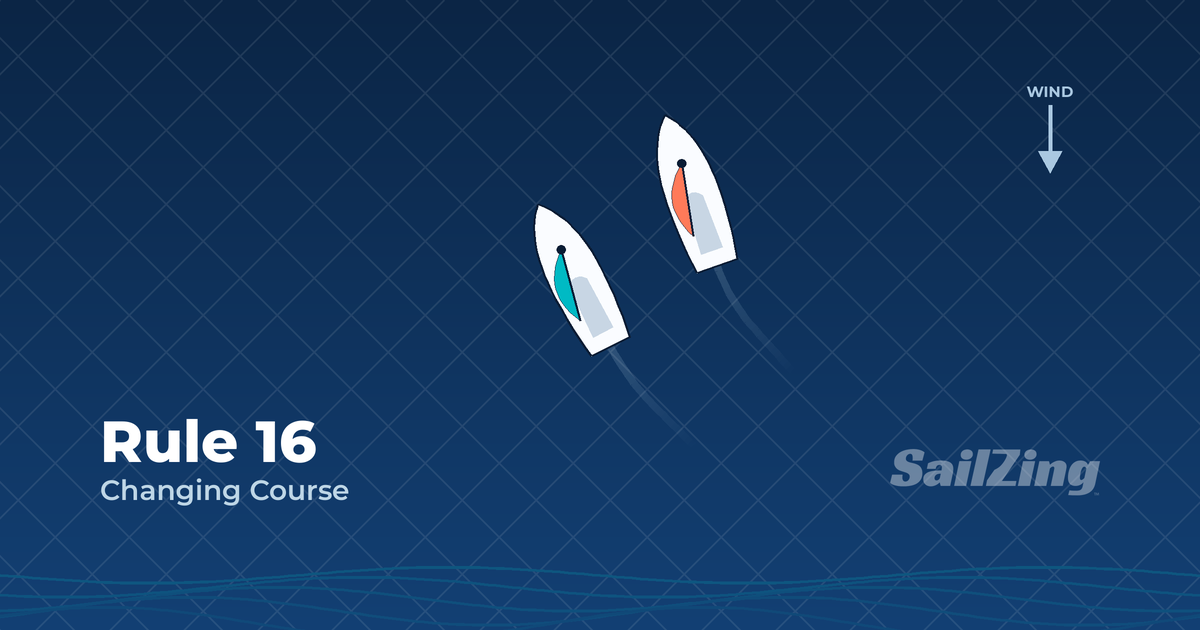
Rule 16 – Changing Course is the third rule in Part 2, Section B of the Racing Rules of Sailing (RRS). This post covers what you need to know about Rule 16, with the rule text, definitions, animations, a quiz on each scenario, and links to the World Sailing Case Book.
In 2018, the Inland Lake Yachting Association (ILYA) and SailZing, LLC partnered on a Fair Sailing initiative. As part of this initiative, SailZing worked with the ILYA and UK Sailmakers to develop a series of articles on the rules. With the rules changes in 2025, SailZing is updating these articles for the 2025-2028 Racing Rules of Sailing.
Our thanks to UK Sailmakers for generating the animated scenarios.
This is our second installment on the rules of Part 2, Section B – General Limitations, after Rule 14 and Rule 15 – Avoiding Contact and Acquiring Right of Way. Remember, the rules in this section don’t change right of way, but they do limit the actions of right-of-way boats.
Rule 16 – Changing Course
16 CHANGING COURSE
Racing Rules of Sailing 2025-2028, Part 2, Section B (World Sailing)
16.1 When a right-of-way boat changes course, she shall give the other boat room to keep clear.
16.2 In addition, on a beat to windward when a port-tack boat is keeping clear by sailing to pass to leeward of a starboard-tack boat, the starboard-tack boat shall not bear away if as a result the port-tack boat must change course immediately to continue keeping clear.
There were no changes to Rule 16, or to the definitions it uses, for 2025-2028.
What Rule 16 Means in Plain Words
- 16.1 applies to every course change by a right-of-way boat. Upwind, downwind, before or after the start: if you have right of way and you turn, the other boat must have room, meaning enough space and time to respond promptly in a seamanlike way.
- 16.2 is an extra limit for one situation. On a beat to windward, when a port-tack boat is keeping clear by planning to pass to leeward (below) a starboard-tack boat, the starboard boat may not bear away (turn away from the wind) if that forces the port boat to change course immediately.
- 16.2 is only about bearing away. If the starboard boat luffs (heads up), 16.1 still applies.
- Rule 16 doesn’t take away right of way. The other boat still has to keep clear. Rule 16 only says the right-of-way boat can’t turn in a way that makes keeping clear impossible.
Definitions
Room. The space a boat needs in the existing conditions, including space to comply with her obligations under the rules of Part 2 and rule 31, while manoeuvring promptly in a seamanlike way.
Keep Clear. A boat keeps clear of a right-of-way boat
(a) if the right-of-way boat can sail her course with no need to take avoiding action and,
(b) when the boats are overlapped, if the right-of-way boat can also change course in both directions without immediately making contact.
Rule 16 Key Points
- This rule limits the ability of a right-of-way boat to change course in order to “hunt” another boat.
- The term “change course” is not defined in the rules. Read plainly, Rule 16.1 is about changing course: a boat that holds her course but slows down, as in Rule 12 Scenario #2, isn’t changing course.
- If you are a right-of-way boat, don’t contribute to “doing the dance” by trying to outsmart the moves of the other boat that is trying to avoid you.
Rule 16 Insights
Various cases in the World Sailing Case Book add insights to this rule. Click the links to read more.
- Case 6: A starboard-tack boat that tacks after a port-tack boat has borne away to go astern of her does not necessarily break a rule.
- Case 52: Rule 16.1 does not restrict the course of a keep-clear boat. Manoeuvring to drive another boat away from the starting line does not necessarily break this rule.
- Case 92: When a right-of-way boat changes course, the keep-clear boat is required to act only in response to what the right-of-way boat is doing at the time, not what the right-of-way boat might do subsequently.
Rule 16 Scenarios
For each scenario, read the description, watch the animation, and choose your answer. Then reveal the answer to check your thinking.
#1 – “Upwind Hunting”
Description: Red and Green are sailing upwind. At location 2, Red bears off to sail below Green. At location 3, Green bears away, and Red heads up in response. At location 4, Green heads up. There is no contact. Green alleges Red did not keep clear – Rule 10. Red alleges Green broke Rule 16.

At location 3, did Green break Rule 16?
Yes. On a beat to windward, Red (port) was keeping clear by sailing to pass to leeward of Green (starboard). When Green bore away at location 3, Red had to change course immediately to continue keeping clear, so Green broke Rule 16.2.
At location 4, did Green break Rule 16?
Yes. Rule 16.1 applies. Green changed course after Red headed up to keep clear. At location 4, when Green headed up, Red did not have room to keep clear.
At location 4, did Red break Rule 10?
Yes, but she is exonerated. Red broke Rule 10 by not keeping clear of Green, but she did so because of Green’s breach of Rule 16.1, so she is exonerated under rule 43.1(a). (Exonerated means excused, with no penalty.) Green’s bear-away (Rule 16.2) and luff (Rule 16.1) were one continuous hunt, so Green takes one Two-Turns Penalty (rule 44.1). If Green had let Red settle and then hunted her again, the protest committee could treat that as a separate incident needing a second penalty, and Red would be exonerated again for any breach Green forced on her.
#2 – “Fast Luff”
Description: Yellow and Blue are sailing downwind. Blue gybes onto starboard tack. Yellow turns sharply to windward, causing contact. Yellow alleges Blue did not keep clear – Rule 11. Blue alleges Yellow broke Rule 16.
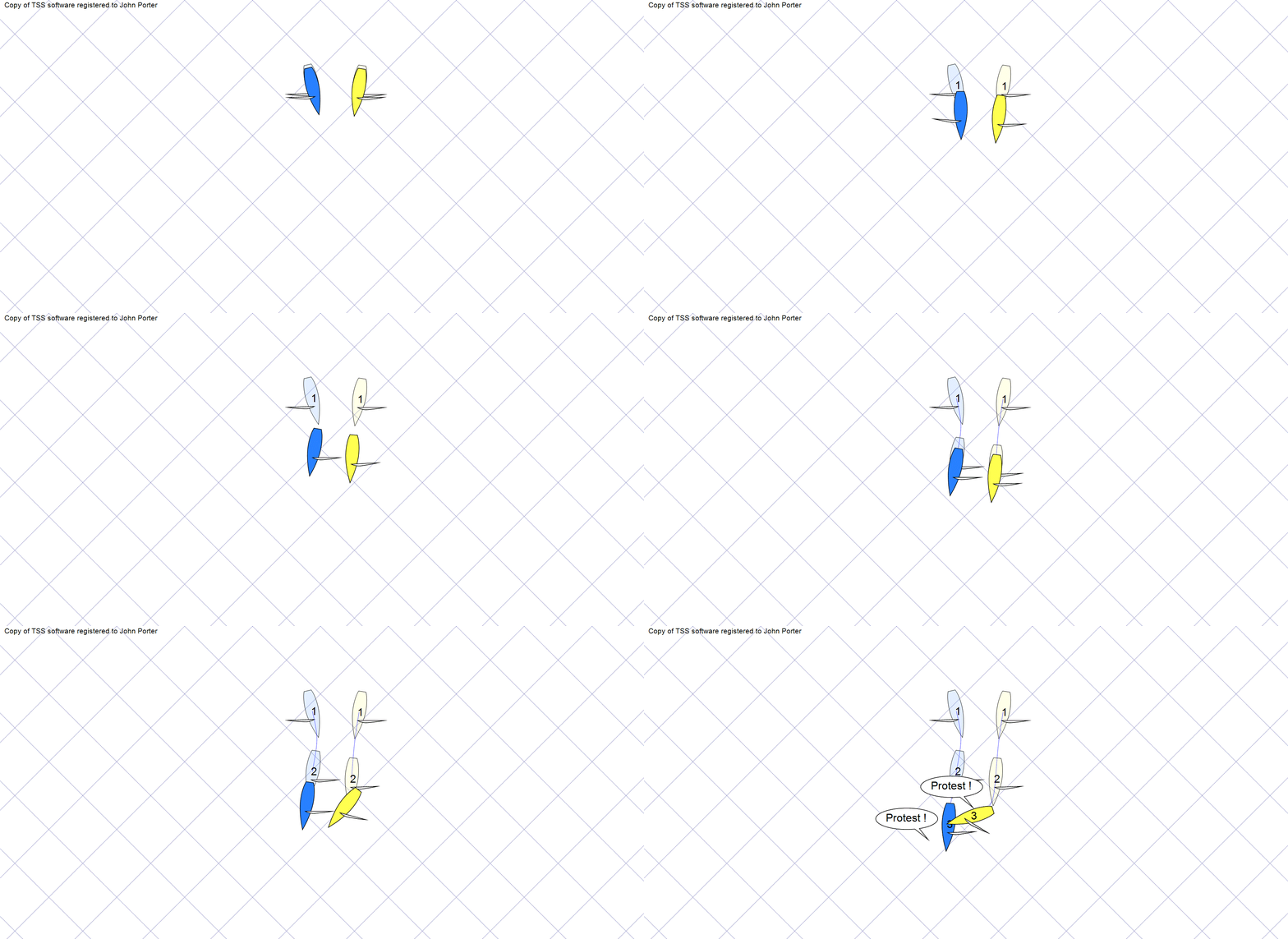
Which boat(s) should promptly take a penalty?
Yellow should take a penalty. Rule 16.1 applies. Yellow is the right-of-way boat, but did not give Blue room to keep clear. Yellow turned so fast that Blue couldn’t respond promptly and in a seamanlike way. At location 3, Blue broke Rule 11, but she is exonerated under rule 43.1(a), since she broke Rule 11 because of Yellow’s actions.
Summary
If you remember one thing, make it this: right of way lets you choose your course, but when you change it, the other boat must have room to keep clear. On a beat, don’t bear away onto a port boat that is ducking you.
If you’re the keep-clear boat, respond to what the right-of-way boat is doing now, and protest if she doesn’t give you room.
Rule 17 – On the Same Tack, Proper Course comes next.
Related Content
- Rule 10 – On Opposite Tacks
- Rule 11 – On the Same Tack, Overlapped
- Rule 12 – On the Same Tack, Not Overlapped
- Rule 13 – While Tacking
- Rule 14 and Rule 15 – Avoiding Contact and Acquiring Right of Way
- Rule 17 – On the Same Tack, Proper Course
- Racing Terms: Glossary for Newer Sailors
- ILYA #FairSailing Initiative
- Racing Rules of Sailing 2025-2028, Part 2, Section B – General Limitations – World Sailing (official rule text)
- World Sailing Racing Rules of Sailing – World Sailing