This post has been updated for the 2025-2028 Racing Rules of Sailing.
Two boats near a mark: does the mark-room rule even apply? Answer that first, and most mark-rounding arguments get simpler.
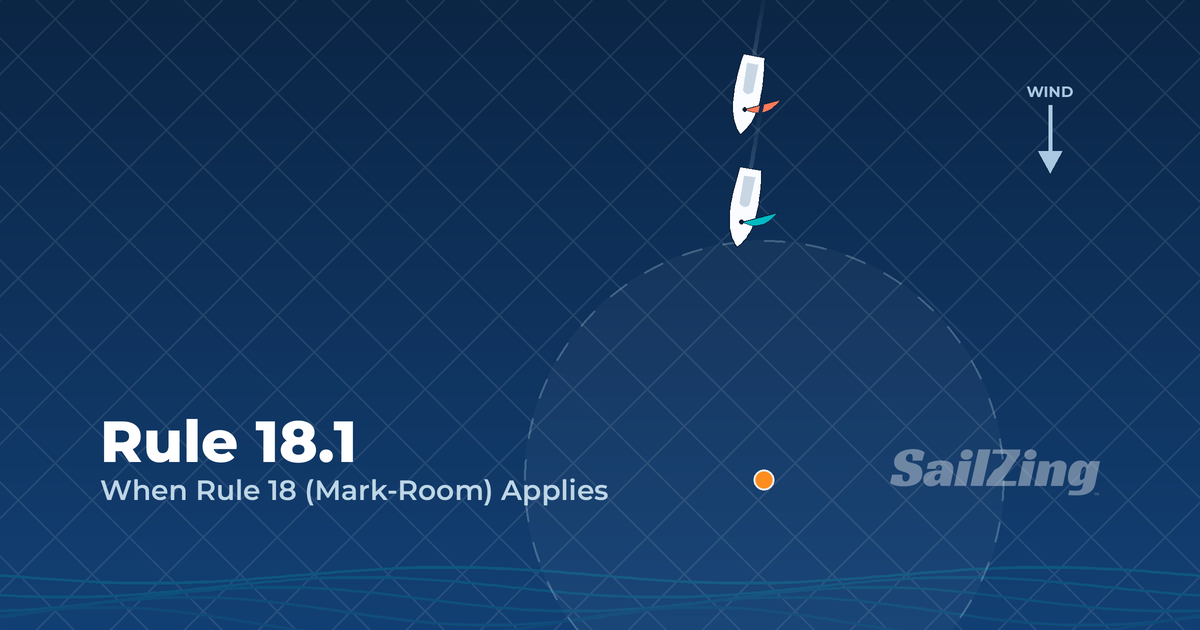
Rule 18.1 – When Rule 18 Applies is the first part of Rule 18 – Mark-Room, in Part 2, Section C – At Marks and Obstructions of the Racing Rules of Sailing (RRS). Section C covers Rules 18, 19, and 20. Rule 18 is complex, so we cover it in three articles, starting here with Rule 18.1, then Rule 18.2, then Rules 18.3 and 18.4.
In 2018, the Inland Lake Yachting Association (ILYA) and SailZing, LLC partnered on a Fair Sailing initiative. As part of this initiative, SailZing worked with the ILYA and UK Sailmakers to develop a series of articles on the rules. With the rules changes in 2025, SailZing is updating these articles for the 2025-2028 Racing Rules of Sailing.
Our thanks to UK Sailmakers for generating the animated scenarios.
Section C Preamble
The preamble to Section C keeps boats from using Rules 18-20 to claim room at a starting mark. It states:
Section C rules do not apply between boats when the mark or obstruction referred to in those rules is a starting mark surrounded by navigable water or at its anchor line, from the time boats are approaching it to start until they have left it astern.
Racing Rules of Sailing 2025-2028, Part 2, Section C (World Sailing)
In plain words: when you’re approaching a starting mark to start (for example the race committee boat at the end of the line), nobody is entitled to mark-room or room at an obstruction there, until the boats have left that mark behind them.
Rule 18.1 – When Rule 18 Applies
18.1 When Rule 18 Applies
Racing Rules of Sailing 2025-2028, Part 2, Section C (World Sailing)
(a) Rule 18 applies between boats when they are required to leave a mark on the same side and at least one of them is in the zone. However, it does not apply
(1) between boats on opposite tacks on a beat to windward,
(2) between boats on opposite tacks when the proper course at the mark for one but not both of them is to tack,
(3) between a boat approaching a mark and one leaving it, or
(4) if the mark is a continuing obstruction, in which case rule 19 applies.
(b) Rule 18 no longer applies between boats when mark-room has been given.
What Rule 18.1 Means in Plain Words
- Two conditions switch Rule 18 on: both boats must leave the mark on the same side, and at least one of them must be in the zone (three hull lengths from the mark).
- Four exceptions switch it off: (1) opposite tacks on a beat to windward; (2) opposite tacks when one boat, but not both, has to tack to round the mark; (3) one boat approaching the mark and the other leaving it; (4) a mark that is a continuing obstruction, such as an island you sail alongside, where Rule 19 applies instead.
- It turns off again when mark-room has been given (18.1(b)). With the 2025 definition Mark-Room, that means room to sail to the mark, round or pass it, and leave it astern. See Rule 18.2 – Giving Mark-Room.
- Rule 18 works on pairs of boats. In a crowd, ask the question for each pair separately.
Definitions
Mark. An object the sailing instructions require a boat to leave on a specified side, a race committee vessel surrounded by navigable water from which the starting or finishing line extends, and an object intentionally attached to the object or vessel. However, an anchor line is not part of the mark.
Zone. The area around a mark within a distance of three hull lengths of the boat nearer to it. A boat is in the zone when any part of her hull is in the zone.
Note: some classes change the length of the zone in the Notice of Race or Sailing Instructions.
Obstruction. An obstruction is
(a) an object that a boat could not pass without changing course substantially, if she were sailing directly towards it and one of her hull lengths from it;
(b) an object that can be safely passed on only one side; or
(c) an object, area or line that is so designated in a rule.
However, a boat racing is not an obstruction to other boats unless they are required to keep clear of her or, if rule 22 applies, avoid her.
Continuing Obstruction. An obstruction is a continuing obstruction when the boat with the shortest hull referred to in the rule using the term will pass alongside it for at least three of her hull lengths. However, the following are not a continuing obstruction: a vessel under way, a boat racing, or a race committee vessel that is also a mark.
Proper Course. A course a boat would choose in order to sail the course as quickly as possible in the absence of the other boats referred to in the rule using the term. A boat has no proper course before her starting signal.
Tack, Starboard or Port. A boat is on the tack, starboard or port, corresponding to her windward side.
Rule 18.1 Changes
For 2025-2028, Rule 18.1 was renumbered into 18.1(a), with exceptions (1)-(4), and 18.1(b). The old unnumbered last sentence is now 18.1(b). Exception 18.1(a)(4) now uses the new defined term continuing obstruction, so there is no zone at a mark that is a continuing obstruction: Rule 19 applies instead. The Section C preamble and the definitions Obstruction, Continuing Obstruction and Proper Course were also reworded.
Why the Change?
Optional reading. Skip ahead to the Rule 18.1 Scenarios if you like.
Rule 18.1. The new layout came from Submission 013-23, Proposal 3, made by the Chair of the World Sailing Racing Rules Committee. The submission gave two reasons:
- The rule that Rule 18 turns off once mark-room has been given “is an important rule and should have a number so sailors and race officials can refer to it in their discussions and decisions.”
- Rules experts argued over when mark-room has been given. The submission says the new Mark-Room definition (“to leave it astern”) resolves that, so the wording of 18.1 “works just fine.”
18.1(a)(4). The Study Version lists the “continuing obstruction” wording as a consequential change resulting from Submission 008-23, Proposal 1 (as amended).
Section C preamble. The Study Version ties the new wording to Submission E06-24 (as amended). The effect: the preamble now applies “between boats when the mark or obstruction referred to in those rules is a starting mark,” and it ends “until they have left it astern” instead of “until they have passed them.”
Sources: World Sailing, 2023 Submissions (013-23); World Sailing, Study Version of the RRS 2025-2028 (change comments); World Sailing, Changes and Corrections, Version 2.
Rule 18.1 Scenarios: Does Rule 18 Apply?
For each example, read the description, look at the diagram, and decide your answer. Then reveal the answer to check your thinking.
#1 – “Example 1”
Description: Yellow and Blue are sailing upwind within the zone near the windward mark.
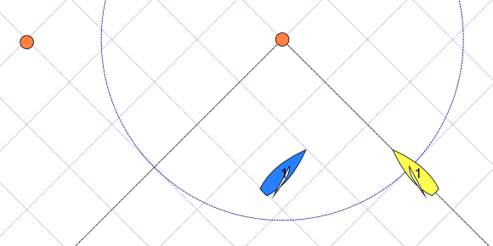
Does Rule 18 apply to Yellow and Blue?
No, Rule 18 does not apply, even though both boats are in the zone. rule 18.1(a) says, in part: “However, it does not apply (1) between boats on opposite tacks on a beat to windward…” Although Rule 18 does not apply at the time shown, it will begin to apply if either boat tacks.
#2 – “Example 2”
Description: Yellow and Blue are sailing upwind within the zone near the windward mark.

Does Rule 18 apply to Yellow and Blue?
Yes, Rule 18 applies, since they are both required to leave the mark on the same side, and at least one of them is in the zone (they are both in the zone). None of the rule 18.1(a) exceptions apply.
#3 – “Example 3”
Description: Yellow and Blue are sailing near the windward mark. Blue is in the zone and does not need to tack to reach the mark.
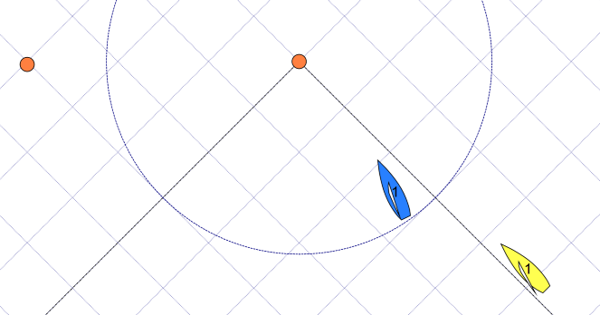
Does Rule 18 apply to Yellow and Blue?
Yes, Rule 18 applies, since they are both required to leave the mark on the same side, and at least one of them is in the zone (Blue is in the zone). None of the rule 18.1(a) exceptions apply. Specifically, since neither boat needs to tack to make the mark, exception 18.1(a)(2) does not apply.
#4 – “Example 4”
Description: Yellow and Blue are finishing upwind. Blue does not need to tack to finish.
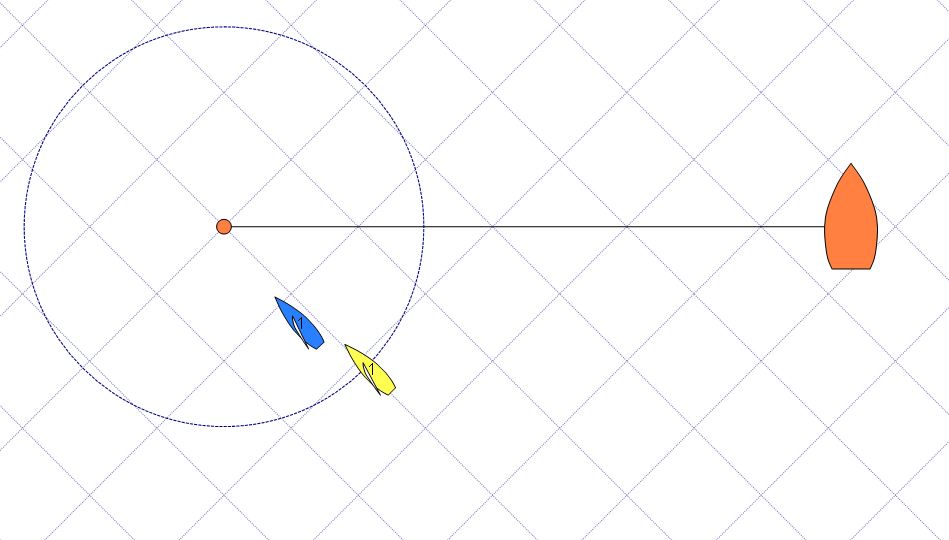
Does Rule 18 apply to Yellow and Blue?
Yes, Rule 18 applies, since they are both required to leave the mark (the finishing mark) on the same side, and at least one of them is in the zone. Since Blue does not have to tack, none of the rule 18.1(a) exceptions apply. If these boats had been on opposite tacks and finishing on a beat to windward, Rule 18 would not apply.
#5 – “Example 5”
Description: Yellow and Blue are sailing downwind to the leeward gate on opposite tacks. Blue is in the zone.
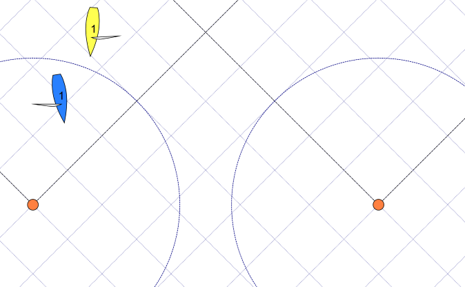
Does Rule 18 apply to Yellow and Blue?
Yes, Rule 18 applies, since both boats are required to leave the mark on the same side, and at least one of them is in the zone. None of the rule 18.1(a) exceptions apply.
#6 – “Example 6”
Description: Yellow and Blue are sailing toward an island. The course requires sailing around the island.

Does Rule 18 apply to Yellow and Blue?
No, Rule 18 does not apply. rule 18.1(a) says, in part: “However, it does not apply … (4) if the mark is a continuing obstruction, in which case rule 19 applies.” The island is a continuing obstruction.
#7 – “Example 7”
Description: Yellow and Blue are sailing downwind with spinnakers to the leeward gate on opposite tacks. Yellow is in the zone. Blue is currently well outside the zone.

Does Rule 18 apply to Yellow and Blue?
Yes, Rule 18 applies, since they are both required to leave the mark on the same side, and at least one of them is in the zone. None of the rule 18.1(a) exceptions apply. Fast boats coming in at wide angles can close in rapidly. Boats entering the zone should look well behind to anticipate mark-room situations.
#8 – “Example 8”
Description: Yellow and Blue are finishing downwind on opposite tacks.
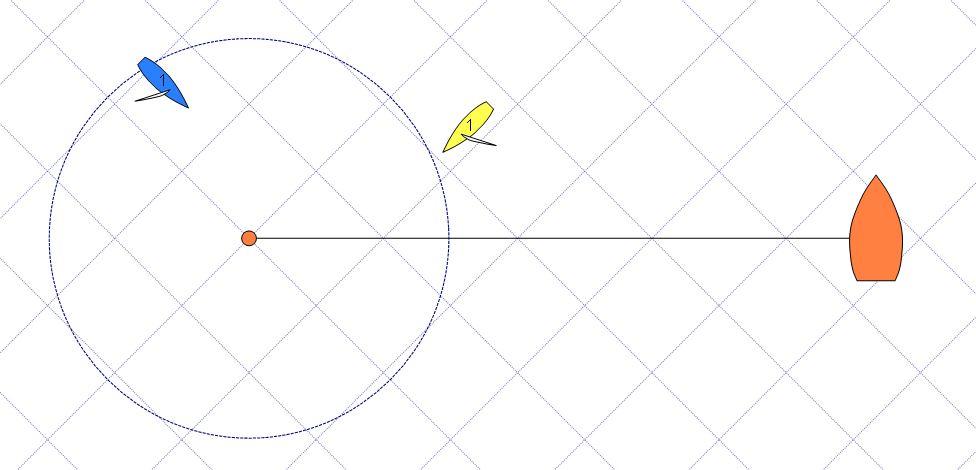
Does Rule 18 apply to Yellow and Blue?
Yes, Rule 18 applies, since they are both required to leave the mark (the finishing mark) on the same side, and at least one of them is in the zone. Even though they are on opposite tacks, none of the rule 18.1(a) exceptions apply.
When Rule 18 Turns Off
rule 18.1(b) says Rule 18 no longer applies between boats when mark-room has been given. We show examples in Rule 18.2 – Giving Mark-Room.
Summary
If you remember one thing, make it this: before arguing about mark-room, check that Rule 18 applies. Same side of the mark, at least one boat in the zone, and none of the four exceptions. Remember the big one: boats on opposite tacks on a beat don’t get mark-room from each other.
Rule 18.2 – Giving Mark-Room comes next.
Related Content
- Rule 14 and Rule 15 – Avoiding Contact and Acquiring Right of Way
- Rule 16 – Changing Course
- Rule 17 – On the Same Tack, Proper Course
- Rule 18.2 – Giving Mark-Room
- Rules 18.3 and 18.4 – Mark-Room 3
- Rules 19-20 – Room at Obstructions
- Racing Terms: Glossary for Newer Sailors
- ILYA #FairSailing Initiative
- Racing Rules of Sailing 2025-2028, Part 2, Section C – At Marks and Obstructions – World Sailing (official rule text)
- World Sailing Racing Rules of Sailing – World Sailing