
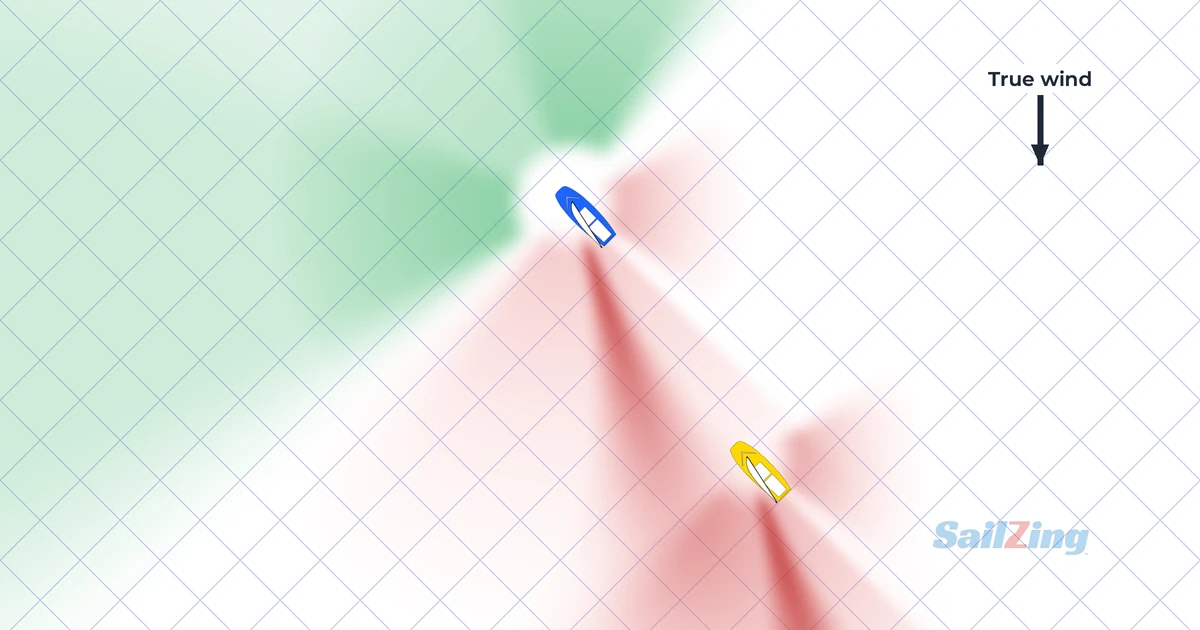
You’re off the line fast, in a clean lane. Then a boat tacks right on your nose, and your boat goes soft under you.
The telltales sag. The tiller goes light. Boats you were beating start climbing past you. Nothing broke, and you didn’t change your trim. You just sailed into her wind shadow, the patch of slow, churned-up air her sails leave behind.
Every mid-fleet racer knows that feeling. Most of us never learn exactly where that bad air sits, so we keep sailing into it. This post shows you how to beat the shadow.
In this post, you’ll learn to see the shadow on the water before it hits you. You’ll know how far it reaches, which way it points, and how to use it against other boats. You’ll also learn when to escape and when to sit tight and take your lumps.
In This Post
What Is a Wind Shadow?
Picture the wind as a smooth river of air. Your sails stick into that river like a rock. Air leaving them comes off slower, more turbulent and bent in a new direction.
That’s the whole idea. Here are the four terms you’ll see in this post:
- Wind shadow (blanket zone). The patch of slower, disturbed air downwind of a boat’s sails, hull and crew.
- Blanketing. Placing your boat so your wind shadow covers another boat.
- Backwind. Air bent off the sails of a leeward boat that hits the boat close to windward of and slightly behind her, at a headed angle.
- Dirty air (bad air). The catch-all term for both shadow and backwind.
One more key point: the shadow lies along the apparent wind (the wind you feel on the moving boat), not straight down the true wind. As coach Dave Dellenbaugh puts it, shadows “angle farther aft than most sailors think.” Upwind, that means the worst air streams back off your leeward quarter, aft of where “straight downwind” (of the true wind) would put it.
Now look at the zones around one boat sailing upwind (darker red is worse):
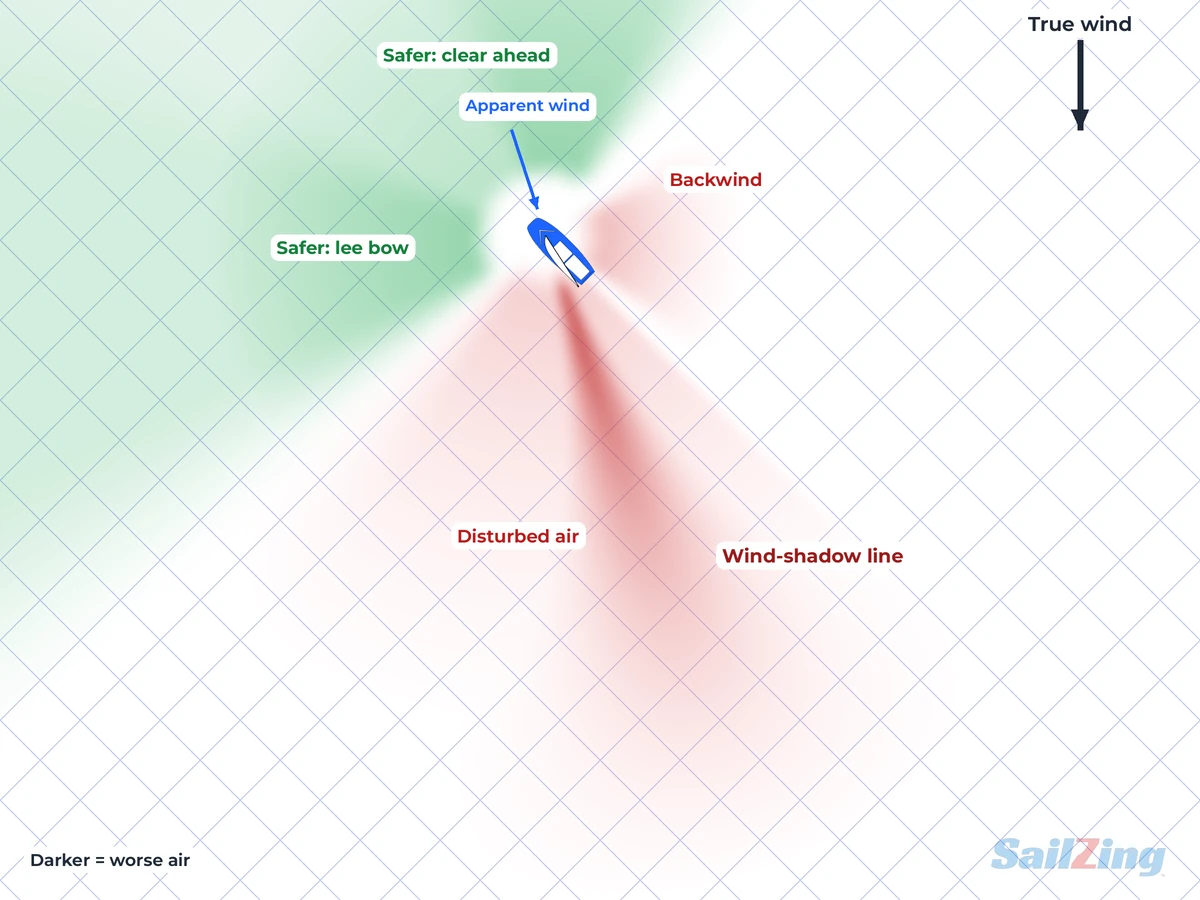
- Avoid: to leeward, from directly under the boat all the way back. This is the primary shadow, the worst air on the water.
- Avoid: to windward and slightly behind. Secondary disturbed air reaches here, and a boat close to windward also gets backwind.
- Safer: to windward and ahead.
- Safer: to leeward and ahead (the lee bow). Here your sails disturb her air, not the other way round.
Now add a fleet. Every boat drags its own red zone, and the zones stack up. Clear lanes are the gaps between them.

So how far back does that red zone really go? Farther than most sailors guess.
How Big Is the Blanket Zone?
- Length. Coaches’ rules of thumb put the shadow at roughly 4 mast-heights in strong wind and 8 or more in light air (Dellenbaugh). Baird says to tack away from a boat ahead within roughly 6–10 lengths. Disturbed air matters farther away than most sailors expect: Dellenbaugh writes that on a run it “may extend many boatlengths” ahead of a boat (Wind Shadows and Apparent Wind, Sailing Breezes; also sail.ie).
- It takes time to arrive. A boat’s disturbed air travels downwind, so it can reach you a little after she has tacked or crossed. Ed Baird (Speed in the Wind Shadow, Sailing World) advises that when a boat crosses and tacks on you, you wait to tack until you feel her header.
- Shape. Disturbed air isn’t a single line. It’s strongest along the wind-shadow line (the primary zone), but it also spreads downwind, backward and upward (the secondary zone). So it can reach a boat slightly above and behind you, too.
- Strength. Shadows are bigger in light air and shorter, but still there, in heavy air. More sail area means a bigger, wider shadow, especially downwind under a spinnaker.
| Class | LOA | Upwind sail area | Sails | Approx. mast (est.) | Approx. shadow reach (est.) |
|---|---|---|---|---|---|
| MC-Scow | 16 ft | 135 sq ft | Main only | ~24 ft | ~100–190+ ft |
| Melges 15 | 15 ft | 133 sq ft | Main, jib; spinnaker downwind | ~23 ft | ~90–180+ ft |
| C-Scow | 20 ft | 216 sq ft | Main only | ~30 ft | ~120–240+ ft |
| E-Scow | 28 ft | 323 sq ft | Main, jib; spinnaker downwind | ~42 ft | ~170–340+ ft |
The shadow swings as you change point of sail. On a close or beam reach, it points to leeward and a little aft. On a run, the apparent and true wind nearly line up, so the shadow points straight ahead at the boats in front of you.

Watch: Sail in Clear Air
This post builds on our most-watched video. Its companion article is Upwind Strategy and Tactics – Sail in Clear Air.
Chapters that match this post:
For this post, we also pulled together explanations from:
- Dave Dellenbaugh, Speed & Smarts: Upwind Tactics, Basic Principles of Strategy, Tacking Techniques; in Sailing Breezes: Converging on Port Tack, Avoid Bad Air from Other Boats, Wind Shadows and Apparent Wind; in WindCheck: Tips on Going Faster in Bad Air
- Ed Baird, Speed in the Wind Shadow (Sailing World)
- Don’t Lurk in Wind Shadows (WindCheck)
- Racing Rules of Sailing 2025-2028 and Case 78 (racingrulesofsailing.org)
The Safe Leeward Position
The safe leeward position is just to leeward and slightly ahead of another boat, with your bow at or ahead of hers. Air leaving your sails is bent back onto her sails, so she’s the one who slows.
This is the idea behind the lee-bow: tacking just to leeward and ahead of a boat on the other tack. To backwind the other boat, you need to be close to leeward, with your bow about even with hers or up to roughly half a length ahead (Dellenbaugh calls half a length “a rough guide” in Converging on Port Tack). Too far back and you’re in her shadow instead.

Backwind: The Other Half of Dirty Air
Backwind comes off the leeward boat’s sails and hits the sails of the boat close to windward of and slightly behind her. It’s strongest when the boats are nearly overlapped and fades quickly as the gap grows.
On a cat-rigged boat like the MC-Scow, it lands right on your mainsail: the luff telltales lift and the boat feels stuck. Tack or foot hard early. Use Gears Tactically for Puffs and Separation explains the technique.
Dirty Air Upwind vs. Downwind
- Upwind. Boats ahead control your air (see the zones above).
- Downwind. It flips. The shadow points forward, so boats behind control the boats ahead.
- Reaching. On a close or beam reach, the shadow points to leeward and a little aft.
Five Ways to Use (or Beat) the Shadow
#1. Attack from behind downwind.
Put your shadow on the boat ahead, then pass her to windward or gybe away into clear air. Once you overlap to windward, you must keep clear under Rule 11. Rule 17 limits her only if she became overlapped from clear astern within two of her hull lengths to leeward of you. Then she may not sail above her proper course while you stay on the same tack and overlapped within that distance, unless in doing so she promptly sails astern of you.
#2. Use it at the start.
Protect a hole to leeward so you can bear off and accelerate in clear air. But never forget the boat to windward who wants to blanket you. Boats focused on the leeward hole can get run over from above.
Roble/Shea Sailing (a video series produced by SailZing in partnership with the ILYA, the Inland Lake Yachting Association) point out that the angle to the line fools you: bow even feels like you’re behind, so the leeward boat needs to sit somewhat ahead of the windward boat. Watch Steph and Maggie talk through eight boats at 30 seconds to go, then try our Starting Tactics Quiz: Boat Thoughts at 30 Seconds.
#3. Defend by covering.
A tight cover puts you directly upwind of her apparent wind, so your shadow slows her. A loose cover stays between her and the mark without shadowing her, so she has less reason to tack away. See Upwind Tactics Principles.
#4. Lee-bow a crossing boat.
When you can’t cross, tacking into the safe leeward position can slow the other boat. You must keep clear while tacking until you’re close-hauled (Rule 13; see our Rule 13 – While Tacking post). Once you have right of way, Rule 15 says you must initially give her room to keep clear.
#5. Defend downwind.
Gybe or head up early so your apparent wind is clear before the trailing boat’s shadow arrives. If you’re the right-of-way boat and change course, Rule 16.1 says you must give the other boat room to keep clear.
How to Get Clear Air: A Quick Checklist
- Look upwind before every tack and gybe. Where will the shadows be after you turn?
- Never forget the boat to windward. At the start especially, she may want to blanket you.
- Tack before you slow down. If you know bad air is about to hit you, tack while you still have speed rather than rebuilding it later.
- Watch the masthead pennant. Your masthead pennant, or another boat’s, shows the apparent wind. The primary blanket zone streams back along the line it points. See Should You Use a Masthead Wind Indicator?.
The animation shows a point Dave Dellenbaugh makes in Speed & Smarts: a boat only turns well with water flowing fast over the rudder, so “don’t tack unless you are up to full speed”. Blue sees she’s about to sail into Yellow’s shadow. She tacks while she’s still fast, before it can slow her.
When to Take Your Lumps
Sometimes tacking clear is strategically or tactically wrong. Then stay in bad air and keep the boat moving. Two common cases:
- Right off the starting line. Speed is essential, and a tack in the crowd costs a lot.
- Approaching a mark in traffic. If other boats leave no room for a clean tack, keep going and look for the next gap.
Dellenbaugh adds that in heavy air bad air hurts less (Avoid Bad Air from Other Boats, Sailing Breezes). Eddie Cox, champion Melges 15 sailor and former Melges 15 lead, held a February 2024 clinic making the same point: in breeze you can punch through another boat’s lee, but in light air you need to be about even with everyone.
Related: 2022 Melges 15 Introduction Interview
When you’re shot out the back, Cox says don’t panic-tack and don’t take big ducks; his limit is about half a boat length. If your lane is only compromised, hold it, look over your shoulder, and wait. If your plan favors that side, it can pay to keep “living in the dirty air until that advantage comes true, until that pressure comes through.” As he put it, “you just gotta take your lumps. It sucks, right?”
Roble/Shea add the other side: don’t hold a bad lane longer than you have to (Bad Start Bail Out Options), and for the first two minutes focus on nothing but speed and your lane (Lane Management after the Start). Our video covers this at 13:27.

How to survive in bad air
Foot, don’t pinch. Ease slightly and power up. As Dave Dellenbaugh writes in Tips on Going Faster in Bad Air (WindCheck):
Usually, the best way out of bad air (unless you can tack) is by footing through it rather than pinching up out of it.
Dave Dellenbaugh, Tips on Going Faster in Bad Air
- Don’t give away too much height. Footing costs height, so only foot off if you’ll stay on this tack long enough to win it back (Dellenbaugh, Avoid Bad Air from Other Boats).
- Shift gears. Add power in the soft spots. See Upwind Tactics for Youth with Roble / Shea Sailing on pinching, VMG and footing.
Make the covering boat tack
If a boat covering you from close to windward has dropped level with you or slightly behind, turn the tables. From the safe leeward position (close to leeward, your bow even with hers or a little ahead), your backwind lands on her sails and makes her slow and uncomfortable. Often she’ll tack away.
One caveat: use the lee-bow this way only if you want to stay on this tack and want her to give up the better tack.
Rules Check: No Rule Against Blanketing
There is no rule against blanketing or backwinding a competitor. Taking another boat’s wind is a normal, legal tactic.
While you do it, the Part 2 rules (When Boats Meet) still apply: Rules 10–13 on right of way, plus Rules 15–17 on acquiring right of way, changing course and proper course. So does Rule 2, Fair Sailing:
A boat and her owner shall compete in compliance with recognized principles of sportsmanship and fair play. A boat may be penalized under this rule only if it is clearly established that these principles have been violated. The penalty shall be a disqualification that is not excludable.
Rule 2, Racing Rules of Sailing 2025-2028
Under Case 78, even tactics that clearly hinder a rival are fine if they could reasonably improve your own final ranking in the event. You break Rule 2 if you use them to help another boat (and the boat you help breaks Rule 41, Outside Help), for reasons unrelated to your result in the event, or if you break a rule on purpose while doing it (and possibly Rule 69.1(a), Misconduct). See What is Fair Sailing?.
Rule 23 limits interfering. If reasonably possible, a boat not racing shall not interfere with a boat that is racing. Also if reasonably possible, a boat shall not interfere with a boat taking a penalty, sailing on another leg, or subject to rule 21.1. After the starting signal, that second part doesn’t apply when the boat is sailing her proper course. See Rules 21-23 – Keeping Clear, Avoiding, Interfering.
Match racing (Appendix C) and team racing (Appendix D) change several Part 2 rules, and controlling an opponent’s wind is a core tactic in both. The notice of race (NoR) and sailing instructions (SIs) can change rules too, so read both.
Where to Start
Start with one habit: before every tack, gybe and start approach, glance at where the boats around you are throwing their shadows. Clear air first, clever moves second.
Quiz: Test Your Wind-Shadow Sense
Read each description, choose your answer, then reveal it.
#1 – “Where’s the Shadow?”
Description: Blue, Yellow and Green sail upwind on starboard tack in a moderate breeze. Yellow is about three lengths behind Blue, off her leeward quarter. Green is about three lengths behind Blue and a length or so to windward.
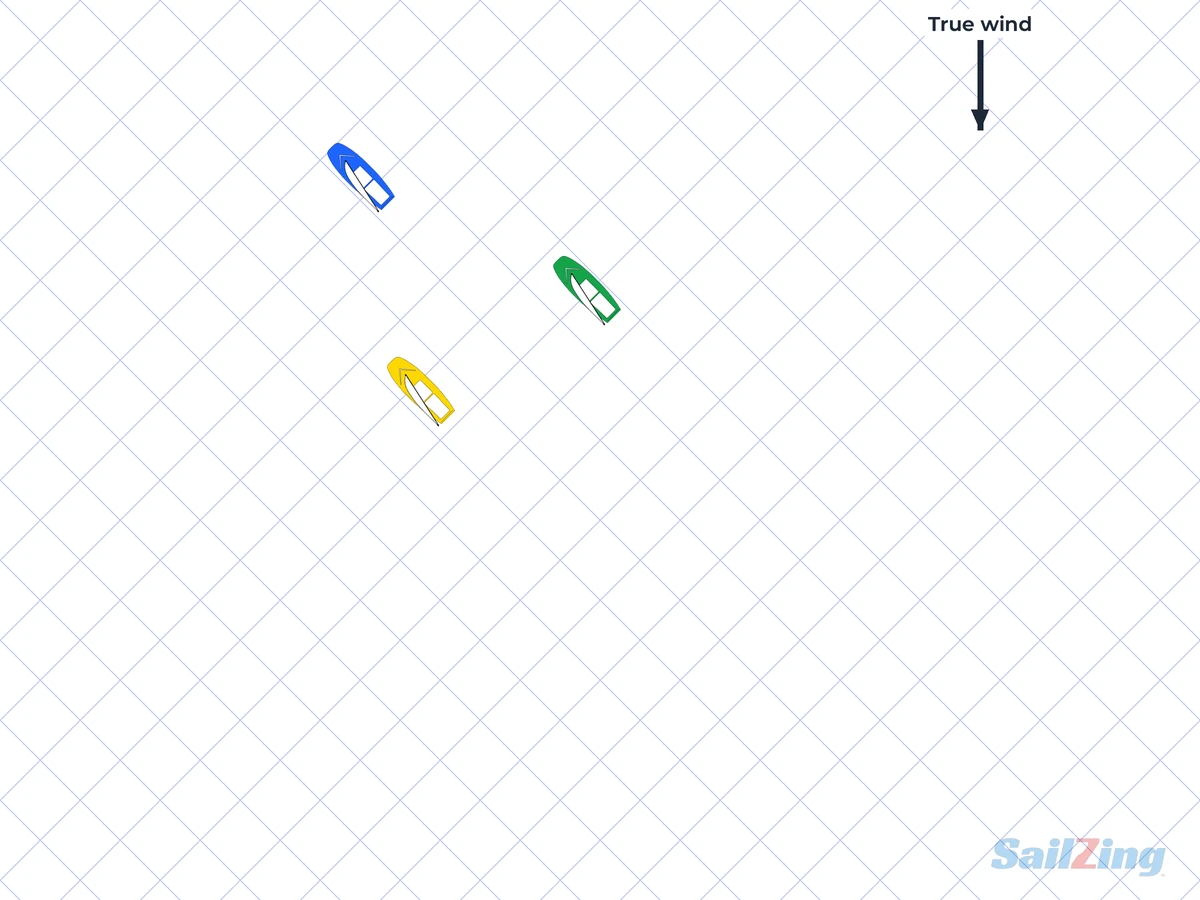
Which boat is in Blue’s wind shadow?
Yellow. Blue’s shadow runs straight down her apparent wind. Upwind that streams back off her leeward quarter, right over Yellow. Green, to windward, is in clear air.
#2 – “Downwind Attack”
Description: On a run, Red is about three lengths directly behind Blue, sailing the same course.
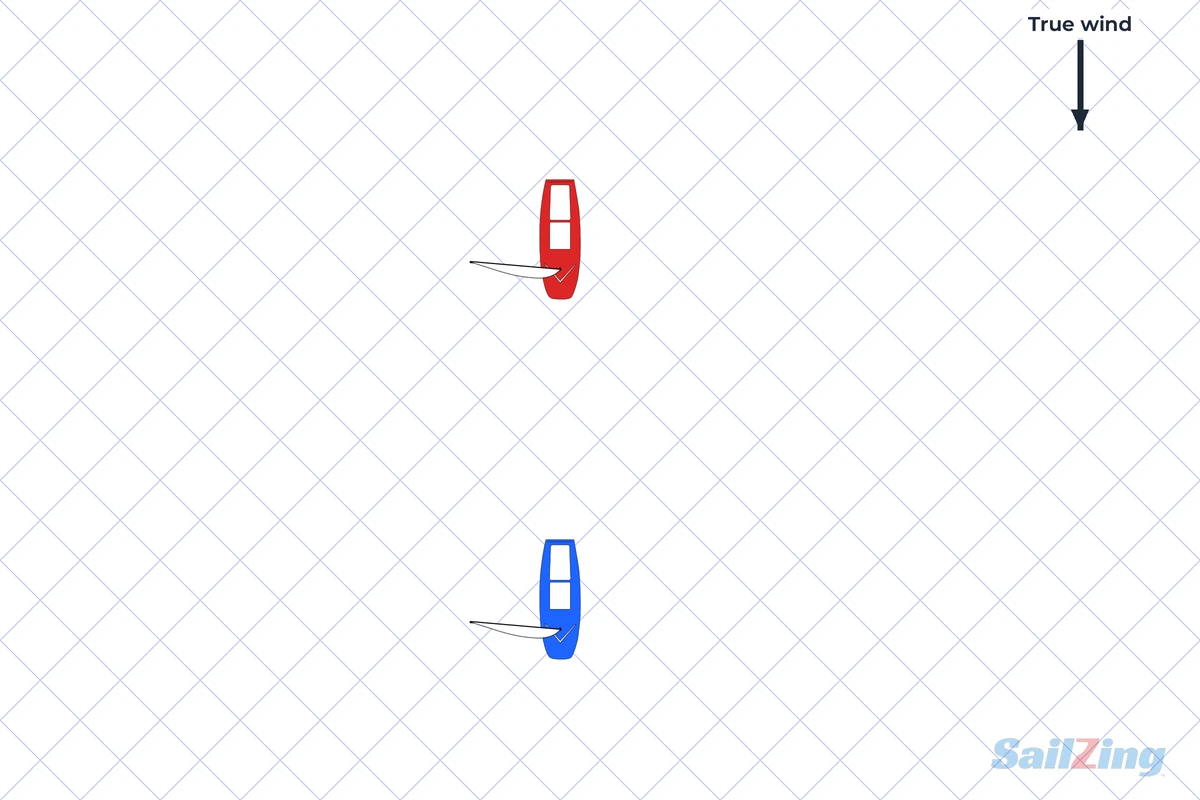
Which boat controls the other’s air?
Red. On a run, the apparent wind comes from behind, so the trailing boat’s shadow points forward onto the leader.
#3 – “Safe Leeward”
Description: Yellow tacks onto starboard just to leeward of Blue, with her bow about half a length ahead of Blue’s bow. Both are close-hauled.
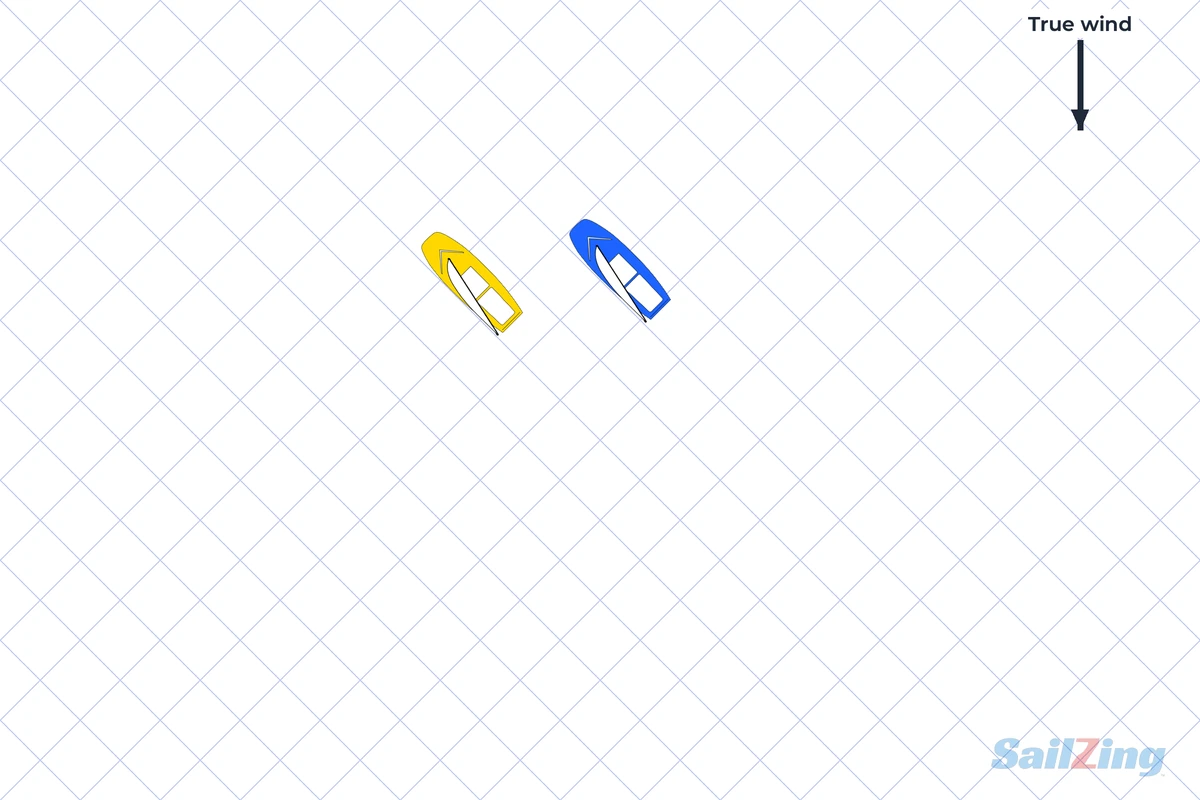
Which boat is slowed by dirty air?
Blue. Yellow is in the safe leeward position, and air leaving her sail backwinds Blue’s mainsail. Blue should tack right away, while she still has speed, rather than wait to be slowed.
#4 – “Is Blanketing Legal?”
Description: In a fleet race, Blue deliberately sails so her wind shadow covers Green, slowing her to protect her own place. Blue keeps clear whenever she is required to and breaks no Part 2 rule.
#5 – “Shake the Cover”
Description: Blue and Yellow sail upwind on starboard. Yellow tacked to cover Blue but ended up close to windward and slightly behind her, in Blue’s backwind. Starboard is the better tack, and Blue wants to stay on it.
Which boat is more likely to tack first?
Yellow. Blue’s backwind lands on Yellow’s sails, so Yellow is slow and uncomfortable and will likely tack to clear her air. That suits Blue: she keeps the better tack, and Yellow gives it up. If port were the better tack, Blue would be sending Yellow the right way.
Related Content
- Upwind Strategy and Tactics – Sail in Clear Air
- Upwind Tactics Principles
- Ladder Rungs: Understand the Race Course with a Visual Approach
- Apparent Wind Clues
- Big Fleet Starts: Challenges and Priorities
- Execute the Start with Four Key Skills
- Downwind Strategy Checklist
- Upwind Strategy Skills Checklist: Master These to Win
- Racing Terms: Glossary for Newer Sailors
- The Racing Rules of Sailing 2025-2028 – World Sailing
