
The Racing Rules of Sailing (RRS) changed on 1 January 2025. At SailZing.com, we have updated our rules articles for 2025-2028, and this page gives you a quick tour of what actually changed, with a short, plain-language reason for each change.
Which rules changed?
- Rule 14 – Avoiding Contact
- Rule 17 – On the Same Tack; Proper Course
- Rule 18.1 – When Rule 18 Applies
- Rule 18.2 – Giving Mark-Room
- Rules 18.3 and 18.4 – Tacking and Gybing in the Zone
- Rule 19 – Room to Pass an Obstruction
- Sail the Course and Finish (definitions and Rule 28)
- Rule 44.3 – Scoring Penalty
- Part 5 – Protests, Hearings and Redress
- Race Signals – Abandonment Signals
- Rules A5.2 and A10 – Scoring Notations
No change needed for RRS 2025-2028 (Part 2): Rule 10 · Rule 11 · Rule 12 · Rule 13 · Rule 16 · Rules 21-23
Rule 10 – On Opposite Tacks

No change needed for RRS 2025-2028. Port keeps clear of starboard: when boats are on opposite tacks, the port-tack boat must keep clear of the starboard-tack boat (a boat’s tack is named for the side the wind comes over; dead downwind or by the lee, it’s the side opposite her mainsail). Keeping clear means the starboard-tack boat can sail her course with no need to take avoiding action and, if the boats are overlapped (for example, both sailing well downwind), can also change course in either direction without immediately touching the port-tack boat.[11]
Read more: Rule 10 – On Opposite Tacks
Rule 11 – On the Same Tack, Overlapped
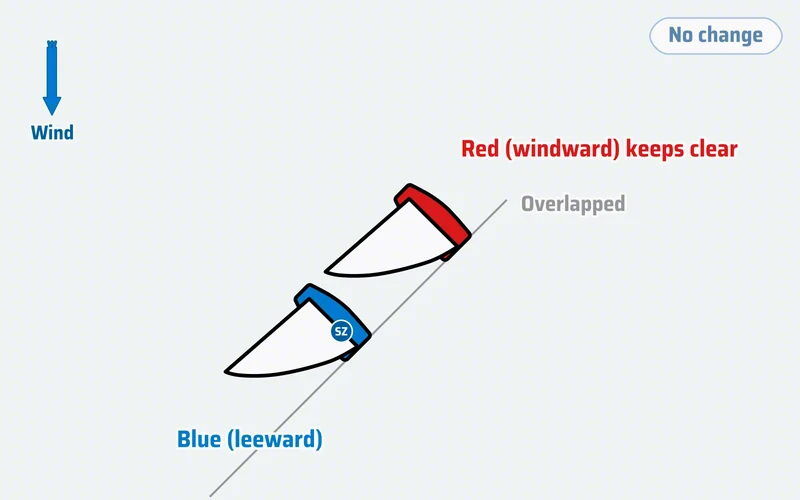
No change needed for RRS 2025-2028. When two boats are on the same tack and overlapped (neither boat is completely behind a line drawn straight across the other boat’s stern, counting hull and equipment in normal position), the windward boat (the one on the other boat’s windward side, normally the side the wind is coming from) keeps clear of the leeward boat.[11]
Read more: Rule 11 – On the Same Tack, Overlapped
Rule 12 – On the Same Tack, Not Overlapped
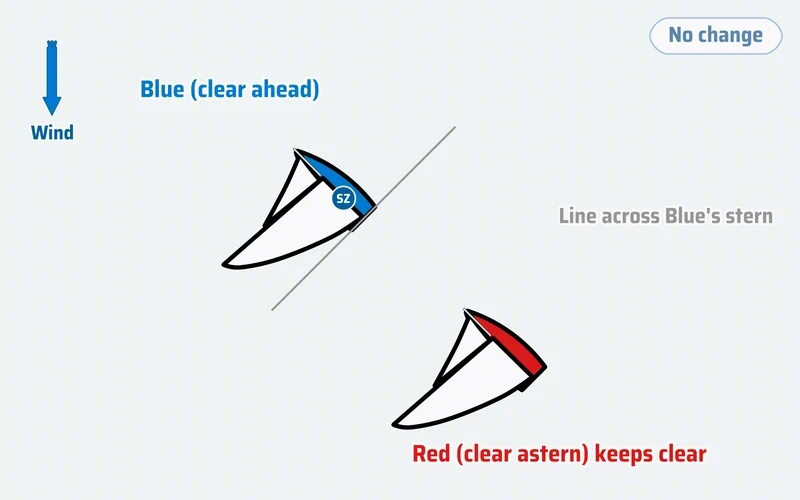
No change needed for RRS 2025-2028. When two boats are on the same tack and not overlapped, the boat clear astern (entirely behind a line drawn straight across the other boat’s stern, counting hull and equipment in normal position) keeps clear of the boat clear ahead.[11]
Read more: Rule 12 – On the Same Tack, Not Overlapped
Rule 13 – While Tacking
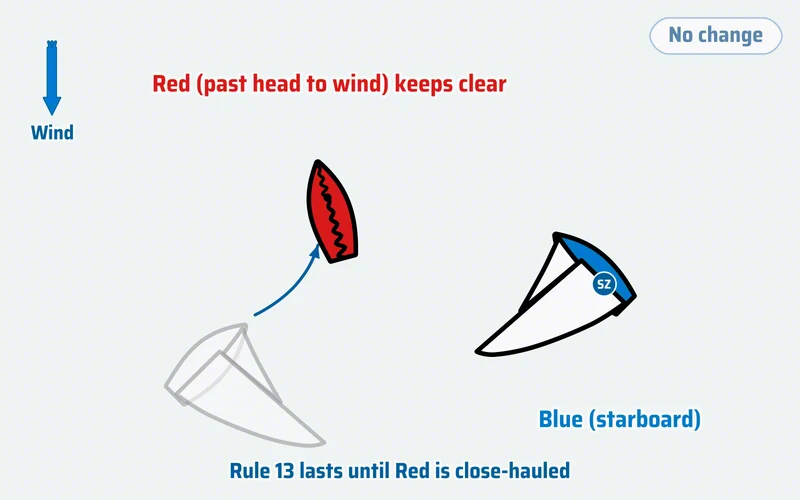
No change needed for RRS 2025-2028. From the moment a boat passes head to wind (bow pointing straight into the wind) until she is on a close-hauled course (sailing as close to the wind as she can while still sailing well), she must keep clear of other boats, and Rules 10, 11 and 12 don’t apply. If two boats are tacking at the same time, the one on the other’s port side or the one astern keeps clear.[11] Rules that did change around tacking include Rule 17 and Rule 18.3 (see below).
Read more: Rule 13 – While Tacking
Rule 14 – Avoiding Contact

Rule 14 now requires boats not to cause contact, not just to avoid contact with another boat. New 14(c) adds that a boat must also not cause contact between a boat and an object that should be avoided, for example a coach boat or another obstruction.[1] The same wording has been used since 2019 in the America’s Cup, since 2020 in the High Speed Rules and since 2021 in Appendix UF, with no negative experiences reported (Submission 012-23).[7] As Dave Perry puts it, “The rule writers want even less contact!”[8] The Mark-Room definition also changed: mark-room now lasts until a boat has left the mark astern (behind her), which settles a long debate about when mark-room has been given.[2]
Read more: Rule 14 and Rule 15 – Avoiding Contact and Acquiring Right of Way
Rule 16 – Changing Course

No change needed for RRS 2025-2028. When a right-of-way boat changes course, she must give the other boat room to keep clear (16.1). On a beat to windward (when both boats are sailing upwind), when a port-tack boat is keeping clear by sailing to pass to leeward of (behind) a starboard-tack boat (a boat’s tack is named for the side the wind comes over; dead downwind or by the lee, it’s the side opposite her mainsail), the starboard-tack boat must not bear away (turn away from the wind) if, as a result, the port-tack boat would have to change course immediately to keep clear (16.2).[11]
Read more: Rule 16 – Changing Course
Rule 17 – On the Same Tack; Proper Course

The last sentence of Rule 17 was deleted. In 2021, Rule 17 did not apply if the overlap began while the windward boat was required by Rule 13 to keep clear (while tacking). Now Rule 17 also applies in that case. It still applies only between boats on the same tack. The Proper Course definition was also reworded. The first 2025-2028 printing used different words, but World Sailing changed them before the rules took effect, so since 1 January 2025 it has read “in order to sail the course as quickly as possible.”[6]
Read more: Rule 17 – On the Same Tack, Proper Course
Rule 18.1 – When Rule 18 Applies

Rule 18.1 has a new layout, and the point at which Rule 18 stops applying (once mark-room has been given) now has its own rule number, so sailors and race officials can refer to it.[8] The new Mark-Room definition (“to leave it astern”) settles when mark-room has been given. The Section C preamble now ends “until they have left it astern,” and it covers starting marks differently.
Read more: Rule 18.1 – When Rule 18 (Mark-Room) Applies
Rule 18.2 – Giving Mark-Room

The “snapshot” rule (the moment the first boat reaches the zone, the three-length circle around the mark) now comes first as 18.2(a), because it is the most used part.[2] It simply asks whether the boats are overlapped or not when the first of them gets to the zone, and that “locks in the rights and obligations of the two boats” at that moment.[2] Old 18.2(c)(2), which Submission 013-23 called “relatively unknown, complex, not necessary,” was deleted.[2] New 18.2(b) switches off 18.2(a) when the boat entitled to mark-room passes head to wind or leaves the zone. In the late-overlap case, 18.2(d) now switches off only 18.2(a) and 18.2(c) between those boats.
Read more: Rule 18.2 – Giving Mark-Room
Rules 18.3 and 18.4 – Tacking and Gybing in the Zone

New Rule 18.3 applies only at a mark you leave to port, when a boat passes head to wind from port to starboard tack inside the zone (within three hull lengths of the mark, measured with the length of whichever boat is nearer it). Between her and a starboard-tack boat (a boat’s tack is named for the side the wind comes over; dead downwind or by the lee, it’s the side opposite her mainsail) that is fetching the mark (able to pass to windward of the mark and leave it on the required side without tacking), Rule 18.2 mark-room doesn’t apply. If that boat has been on starboard since entering the zone, the boat that tacked must not make her sail above close-hauled to avoid contact, and must give her mark-room if she becomes overlapped inside. Rule 18.4 got a new title that parallels 18.3, to make the rules easier to read, understand and remember.
Read more: Rules 18.3 and 18.4 – Tacking and Gybing in the Zone
Rule 19 – Room to Pass an Obstruction

Rule 19 now gives way to Rule 18 at a mark only when Rule 18 applies between the two boats. A new sentence in 19.2(a) makes clear that the right-of-way boat may choose which side to pass an obstruction, but if she changes course when choosing, she must give the other boat room to keep clear. This codifies how Rule 19 was already being interpreted (Submission 008-23).[3]
Read more: Rules 19-20 – Room at Obstructions
Rules 21-23 – Keeping Clear, Avoiding, Interfering

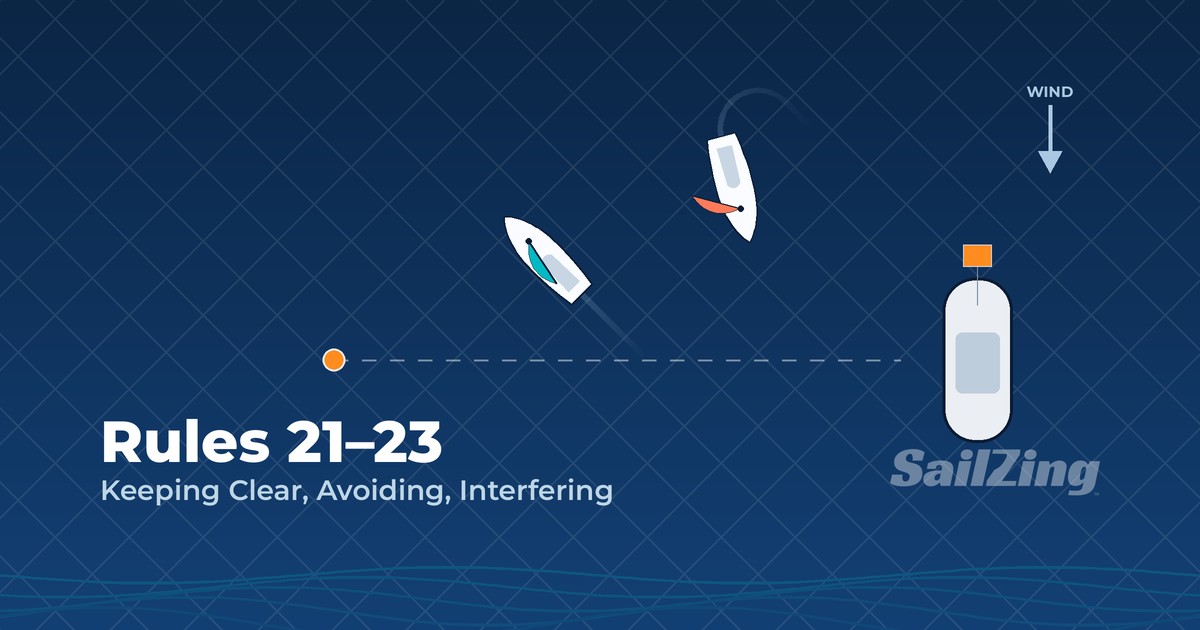
No change needed for RRS 2025-2028. (Rule 23.2’s ‘proper course’ exception uses a definition that was reworded for 2025-2028: a proper course is a course a boat would choose to get around the race course as quickly as possible if the other boat the rule is talking about weren’t there.) Rule 21 tells three kinds of boat to keep clear of boats that aren’t doing the same thing. First, a boat sailing back towards the pre-start side (the side of the line boats start from, opposite the course side) of the starting line or its extensions after her starting signal, to start or to comply with Rule 30.1 (the I flag rule: if flag I went up with the preparatory signal and any part of a boat’s hull is on the course side of the line or its extensions in the last minute, she must sail back around an end, across an extension, so her hull is completely on the pre-start side before she starts), until her hull is completely on the pre-start side. Second, a boat taking a penalty. Third, a boat moving astern, or sideways to windward, through the water by backing a sail (holding a sail out so the wind fills it from the wrong side). While Rule 21 or 22 applies between two boats, the normal right-of-way rules (10-13) don’t. Rule 22: if possible, avoid a boat that is capsized or hasn’t regained control after capsizing, is anchored or aground, or is trying to help a person or vessel in danger. Rule 23: if reasonably possible, a boat that isn’t racing must not interfere with one that is, and, if reasonably possible, no boat may interfere with a boat that is taking a penalty, sailing on another leg, or sailing back to the pre-start side under Rule 21.1. After the starting signal, that second limit doesn’t apply to a boat sailing her proper course.[11]
Read more: Rules 21-23 – Keeping Clear, Avoiding, Interfering
Sail the Course and Finish (definitions and Rule 28)

The definition of sailing the course now includes starting and finishing, undoing what US Sailing calls “the unintended consequences” of the 2021 change.[10] That lets many other rules drop their separate references to starting and finishing: a boat that does not start or finish has not sailed the course.[9] Under the reworded Finish definition, a boat can finish without having started.
Read more: Conduct of a Race
Rule 44.3 – Scoring Penalty
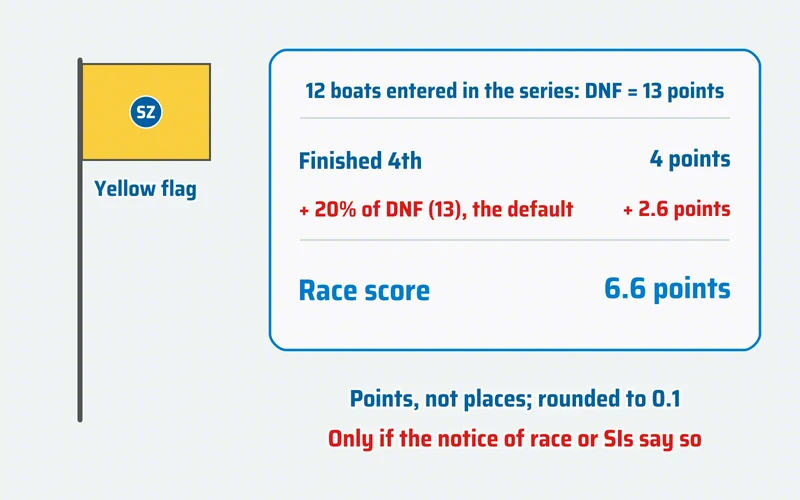
The Scoring Penalty is now available only “if specified in the notice of race or sailing instructions.” Rule 44.3(c) now adds points rather than places, and the default 20% penalty is rounded to the nearest tenth of a point instead of a whole number.
Read more: Exoneration and Penalties
Part 5 – Protests, Hearings and Redress

Part 5 was rewritten. Over several rule cycles it had become more complicated as changes were made to fix different issues, and the new draft was meant, as far as possible, to keep the same actual consequences (Submission 022-23).[4]
Read more: Protests, Hearings and Redress
Race Signals – Abandonment Signals

The N, N over H and N over A flags now abandon only races in progress, not races that have already finished. Submission 002-23 (US Sailing) notes that the old “all races” wording could be, and had been, interpreted as abandoning races that had already finished. The new wording makes clear that only races in progress are abandoned.[5][10]
Read more: Race Signals 2025-2028: Summary and Quiz
Rules A5.2 and A10 – Scoring Notations

SCP now reads “Scoring Penalty imposed” instead of “applied.” NSC (did not sail the course) is now used only when none of DNC, DNS, OCS or DNF fits, and rule A5.2 no longer lists “did not start” or “did not finish”, because the new Sail the Course definition already covers starting and finishing.[9]
Read more: Sailing Scoring Notations
Related reading: What is Fair Sailing?
If we missed a basic concept, feel free to comment below.
Sources
- World Sailing, The Racing Rules of Sailing 2025-2028, rule 14.
- World Sailing Submission 013-23, Rule 18, Definition Mark-Room, Preamble Part 2 Section C (2023 Annual Conference). PDF
- World Sailing Submission 008-23, Definition Obstruction, New definition Continuing Obstruction, rule 19 (2023 Annual Conference). PDF
- World Sailing Submission 022-23, Part 5 (2023 Annual Conference).
- World Sailing Submission 002-23 (US Sailing), Race Signals N, N over H, N over A (2023 Annual Conference).
- World Sailing, Changes and Corrections to The Racing Rules of Sailing for 2025-2028, Version 2, sailing.org/racingrules. Its changes, including the Proper Course definition, took effect 1 January 2025. Its later corrections (rules A6.1 and E6.3) took effect 20 April 2026.
- World Sailing, Racing Rules of Sailing 2021-2024 High Speed Edition, and Appendix UF (Umpired Fleet Racing). PDF
- Dave Perry, A Quick Overview of the Significant Rule and Game Changes, US Sailing, January 2025.
- RYA, Changes to the racing rules: The main changes to the Racing Rules of Sailing effective from January 2025 (December 2024 v2).
- US Sailing Race Management Committee (Mark Townsend and Bill Stump), 2025-2028 Racing Rules of Sailing: Important Changes Affecting Race Management (amended 7 January 2025).
- World Sailing, The Racing Rules of Sailing 2025-2028, Part 2, Sections A, B and D (rules 10-13, 16 and 21-23), sailing.org/racingrules (2025-2028 RRS with Changes and Corrections, PDF) (also on racingrulesofsailing.org: rules 10-13, rule 16, rules 21-23).