
The starting gun fires. Forty MC-Scows charge the line, sails snapping, and from the dock it looks like a white wall moving upwind. So who’s actually winning?
You can answer that. With the right vantage point and a few cues, a lake regatta turns into a game you can read from start to finish. Better yet, the same cues that make spectating fun are the ones top racers use to get faster.
In this post, you’ll get creative ways to watch an inland lake race: from shore, from a spectator boat, from a kayak or paddleboard, and from your phone. You’ll learn what the flags mean, how to spot who’s really ahead, and how to watch like a coach so you bring lessons back to your own boat. It’s built for up-and-coming racers and for the families, friends, and fans cheering them on.
For this post, we pulled together:
- Spectator rules from real regatta instructions: the 2022 U.S. Youth Championship Sailing Instructions (US Sailing) and the 2026 Fall Fury Notice of Race on Lake Mendota
- Official race signals from the Racing Rules of Sailing 2025-2028
- Wake and no-wake law from the Wisconsin Statutes §30.66 and the Wisconsin DNR
- Paddle and life jacket guidance from the U.S. Coast Guard Boating Safety FAQ
- Drone rules from the FAA
- Live-tracking tools used at scow and Melges events (Vakaros RaceSense, Kwindoo LiveView, TracTrac)
- SailZing.com’s own beginner race-course series and the Roble/Shea Sailing series
In This Post
- Know the Course Before You Go
- Nine Creative Ways to Watch
- Read the Flags: What’s Happening Now
- Who’s Winning? Read the Race From a Distance
- How to Watch Like a Coach
- Photo Tips and Bringing Kids
- Spectator Quick Sheet
Know the Course Before You Go
A race course is a set of floating marks (big inflatable buoys) the boats sail around in a set order. On most lake regattas, the course is a “windward-leeward”: up into the wind, then back down, two or three times.
What the course board means
Before each race, the RC boat shows a short code on a board that tells the sailors which course to sail. On many lake courses you’ll see “WA2.” The boats sail upwind to the windward mark, round a small offset mark just past it (that’s the “A”), run downwind to the leeward gate, then sail back upwind to finish. A leeward gate is two marks set side by side. Boats sail down through the gate (between the marks), then rounding a mark out to either side before heading back upwind. The “W” means a windward finish, and the “2” means two upwind legs. Each event’s Sailing Instructions (SIs) define its own codes, and Use Race Course Types to Set Strategy explains the main course shapes.
A few terms you’ll hear on the dock
- Start line. An imaginary line between the race committee (RC) boat (the anchored boat running the race, usually flying flags) and a buoy called the pin. Boats must be behind it when the start signal goes.
- Windward mark. The mark straight upwind of the start, where boats turn to head downwind. It’s usually the most exciting rounding to watch.
- Leeward gate. Two marks at the bottom of the course. Boats can round either one, which splits the fleet.
- Finish line. Often between the RC boat and a mark near the start, marked by a blue flag on the RC boat.
How to tell the finish is set up. Watch for these signs:
- A blue flag goes up on the RC boat or a separate finish boat. The rulebook says: “The staff displaying this flag is one end of the finishing line.”
- A boat moves and anchors at one end of the course. The finish is often at the top, near the windward mark, or at the bottom, near the leeward gate.
- A buoy goes in near that boat. The finish line is an invisible line between the flag on the boat and that buoy, called the finish mark.
- A horn sounds when the first boat finishes. The rest of the fleet usually crosses without one.
- Flag S (blue square on white) with two horns means “The course has been shortened.” Boats finish early, at a line the RC sets up on the course.

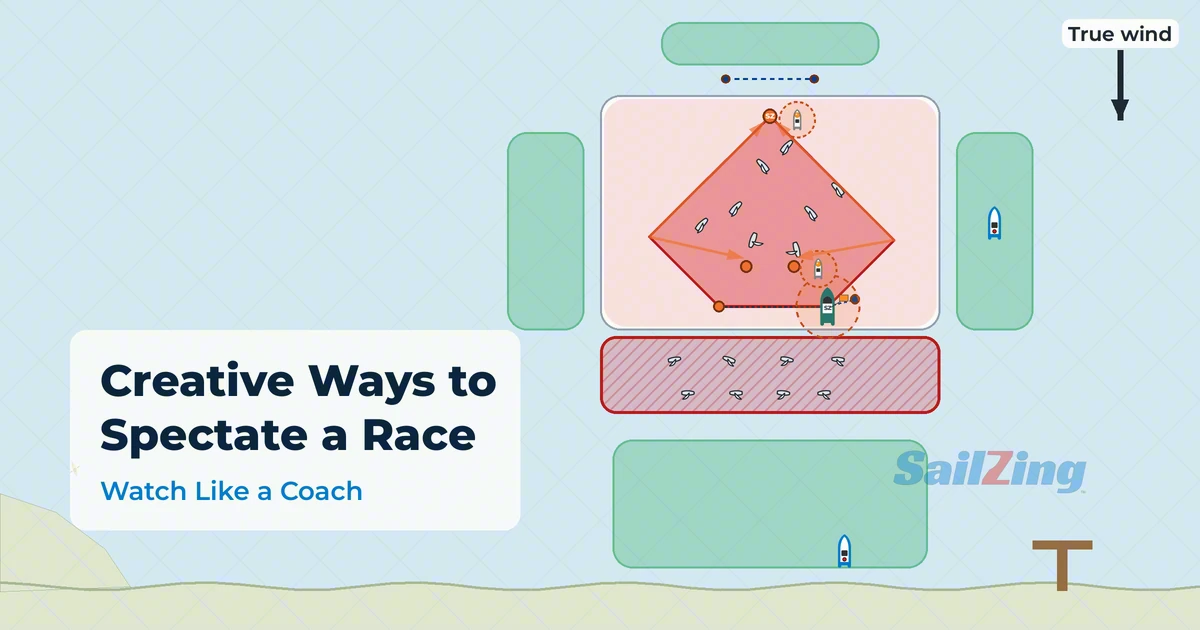
See the map above. The red race diamond is off-limits, the lighter corners are keep-clear, and the arrows mark the lanes where boats come straight at you. Notice the green spectator zones sit well outside the course: off to the sides, well beyond the windward mark at the top (some courses finish up there, so it’s a great seat for the finish), and at the bottom, below the pre-start zone. That’s where your boat’s wind shadow and wake bother nobody. Check the event’s Notice of Race (NOR) or Sailing Instructions (SIs) for the actual spectator area. Many events post a course diagram there. For more on how courses shape strategy, see Use Race Course Types to Set Strategy from the Roble/Shea Sailing series, produced by SailZing in partnership with the ILYA (Inland Lake Yachting Association).
Nine Creative Ways to Watch
Three moments bring the biggest drama: the start, the finish, and crowded mark roundings where boats fight for room. Those packed roundings live up there with fights in hockey.
#1. Claim a point, a dock, or the club deck
Lakes are made for shore watching. A point that pokes out toward the course puts you close to a mark. A club deck or a lakeside lawn near the start line gives you the starts, which are often the best show of the day.
Pro move: Ask a club member where the marks usually go for the wind direction that day. On a north wind, the windward mark may sit near one shoreline; on a south wind, it’s across the lake.
Big events plan for this. Ahead of the 2026 ILYA Annual Championship at Minnetonka Yacht Club, organizers said spectators could watch from their own boats or from the Cottagewood/Deephaven shoreline (Lake Minnetonka Magazine, July 2026). See the ILYA regatta page for event details.
#2. Ride the spectator boat or bring your own
A powerboat or pontoon lets you follow the fleet around the course. Your boat can hurt racers in two ways: its wind shadow steals their breeze, and its wake knocks them off their stride. Here’s the etiquette racers love:
- Stay outside the course. The 2022 U.S. Youth Championship SIs required spectator vessels to “stay 500 feet outside the race course.” The 2026 Fall Fury NOR on Lake Mendota required spectators to “remain at least 100 yards from the competitors while racing.” Every event sets its own number, so read the NOR/SIs.
- Never enter the race diamond. Racing boats can’t sail straight into the wind; close-hauled, they sail about 45° off it on each tack. So from the start line, boats fan out on 45° lines toward the side corners, then tack and come back in to the windward mark on the laylines (the 45° lines that just reach the mark). That diamond belongs to the racers. Some sailors gamble and sail all the way out to the corners, so give the lighter-shaded corner zones a wide berth too. Spectators stay outside it for the entire race.
- Give the RC boat and mark boats plenty of room. The race committee moves marks, shifts lines and signals the fleet all race long. Mark boats (small powerboats that set and move the buoys) need a clear path. Park well away from both.
- Stay leeward of boats that are racing near you. Never park just upwind of the fleet. The one exception is the green zone well beyond the windward mark. Stay far enough upwind of it that your wind shadow and wake never reach boats coming up the laylines or rounding the mark. Your boat blocks wind just like a sail does (see Beat the Shadow: How to Find, Use and Escape Bad Air).
- Stay out of the pre-start zone. Below the start line, boats crisscross at speed for several minutes while they set up for the start. At events with several fleets, the next fleet waits and maneuvers in a second band just below them. Treat that whole area like the race diamond: stay out, and watch from the green zone further down.
- No wake near racers. Your wake rolls across the course and knocks small boats off their stride, even from far away. Idle when you’re near the fleet.
- Anticipate sailing angles. Sailboats can’t sail straight into the wind, so they zigzag upwind. They reach the windward mark on the laylines: the lines a boat can sail and just make the mark without tacking again. Expect streams of boats on both laylines. Downwind, boats sail broad angles and jibe (swing the stern through the wind), cutting wide across the lake. Read where each boat goes next, and never sit in that path. Think well ahead and move early. Spectator boats, kayaks and SUPs are usually much slower than the racing sailboats, so you can’t wait until the last minute to get out of someone’s way.
- Know local law. In Wisconsin, for example, motorboats must stay at slow-no-wake within 100 feet of any dock, raft, pier, or buoyed restricted area on any lake (Wis. Stat. §30.66(3)(a)). Personal watercraft must stay at slow-no-wake within 200 feet of the shoreline (§30.66(3)(ar)). As Lt. Darren Kuhn, the Wisconsin DNR Boating Law Administrator, put it (July 26, 2024): “Wake responsibility is not just about safety; it’s about respect for our beautiful natural resources and fellow water enthusiasts.”
- Never talk to racers during a race. The U.S. Youth SIs banned spectator boats from communicating with racing boats “during or between races.” Cheer from a distance, then celebrate at the dock.
#3. Throw a pontoon party (the smart way)
A pontoon with family, snacks, and a flag chart is the classic lake regatta hangout. Anchor or drift in the spectator zone, leeward of the gate, and you’ll see boats roar downwind toward you. Assign one person to watch the flags, one to run the tracking app if the event has one, and one to handle the boat.
#4. Paddle out: kayak, canoe, or SUP
A folding kayak in your trunk means you never miss the action. A kayak or paddleboard lets you set up on your own schedule, near the shore end of a mark.
Paddle with purpose:
- Wear a life jacket. Federal rules require a Coast Guard-approved wearable life jacket for each person aboard, and a kayak, canoe, or SUP counts as a vessel once you’re outside a swimming, surfing or bathing area. Children under 13 must wear one on a vessel that’s underway (USCG Boating Safety FAQ). State rules can differ and apply on state waters. Carrying one is the law; wearing it is the smart move.
- Hug the shore. Stay well outside the course. Scows move fast, and a racing helmsman is watching sails and wind, not paddlers.
- Watch the traffic. Powerboat wakes on busy lakes are bigger than they look from a dock.
- Bring a whistle, phone in a dry bag, and sun protection.
#5. Use binoculars
A pair of binoculars turns a blur of sails into individual boats. Read sail numbers, spot who tacked first, and watch crews’ body weight move during a tack. A compact 8x pair is a good pick. REI’s buying guide (Ken Knapp) recommends sticking with “a lower magnification such as 8 or less” on the water, “because a higher (10-power) magnification can make steady viewing challenging” (REI Expert Advice).
#6. Check for live tracking online
Check whether your venue allows live viewing online. Not every event does. Sometimes apps such as Vakaros RaceSense, Kwindoo LiveView (a spectator app that needs no account) or TracTrac let you follow the fleet on your phone, on the dock or a thousand miles away. RaceSense has been used at championships such as the 2024 Melges 15 US National Championship and the 2024 E Scow Blue Chip at Pewaukee Yacht Club. Look for a tracking link on the regatta page or class site before race day.
Pro move: Combine tracking with your eyes. The app shows positions; your binoculars show why (a puff, a shift, a bad tack).
#7. Think twice before flying a drone
The pull is real. A drone can give you a unique and wonderful view of a race: the whole fleet at once, the line-up on the start, and who found the pressure. But for most spectators, it probably isn’t the right choice. Here’s why:
- FAA rules. Recreational flyers aren’t permitted to fly over people or moving vehicles (FAA), and a race course is full of crewed boats and crowded spectator boats. You also have to keep the drone within your own visual line of sight (FAA Recreational Flyers).
- Other drone traffic. Event videographers chasing a tight start-line shot can come flying down the line focused on their frame, not on who else is in the air.
- Wind and weather. Gusts and fast-changing conditions over open water can push a small drone off course or down.
- Battery life. Cold and gusty conditions drain batteries fast, and there’s nowhere to land but the water or a boat.
- Distance. The course can be far from shore, and the farther out you fly, the harder it is to see your drone and get it back.
Finally, check the Notice of Race (NOR), the Sailing Instructions (SIs) and the venue’s rules. Some prohibit drones entirely. For the big-picture view, a high spot on shore or event video is usually the better bet.
#8. Follow the course map and the “board”
At many clubs, the RC posts the course on a board on the RC boat (letters or numbers that tell boats which marks to round). Grab the course diagram from the SIs and keep it on your phone. Then you’ll know whether the fleet does two laps or three, and when the finish is coming.
#9. Watch from home, then debrief together
Some events stream video or post replays. Watch the replay with your sailor afterward and pause at key moments: the start, the first shift, the windward mark. It’s one of the best learning tools on this list (more in How to Watch Like a Coach).
Read the Flags: What’s Happening Now
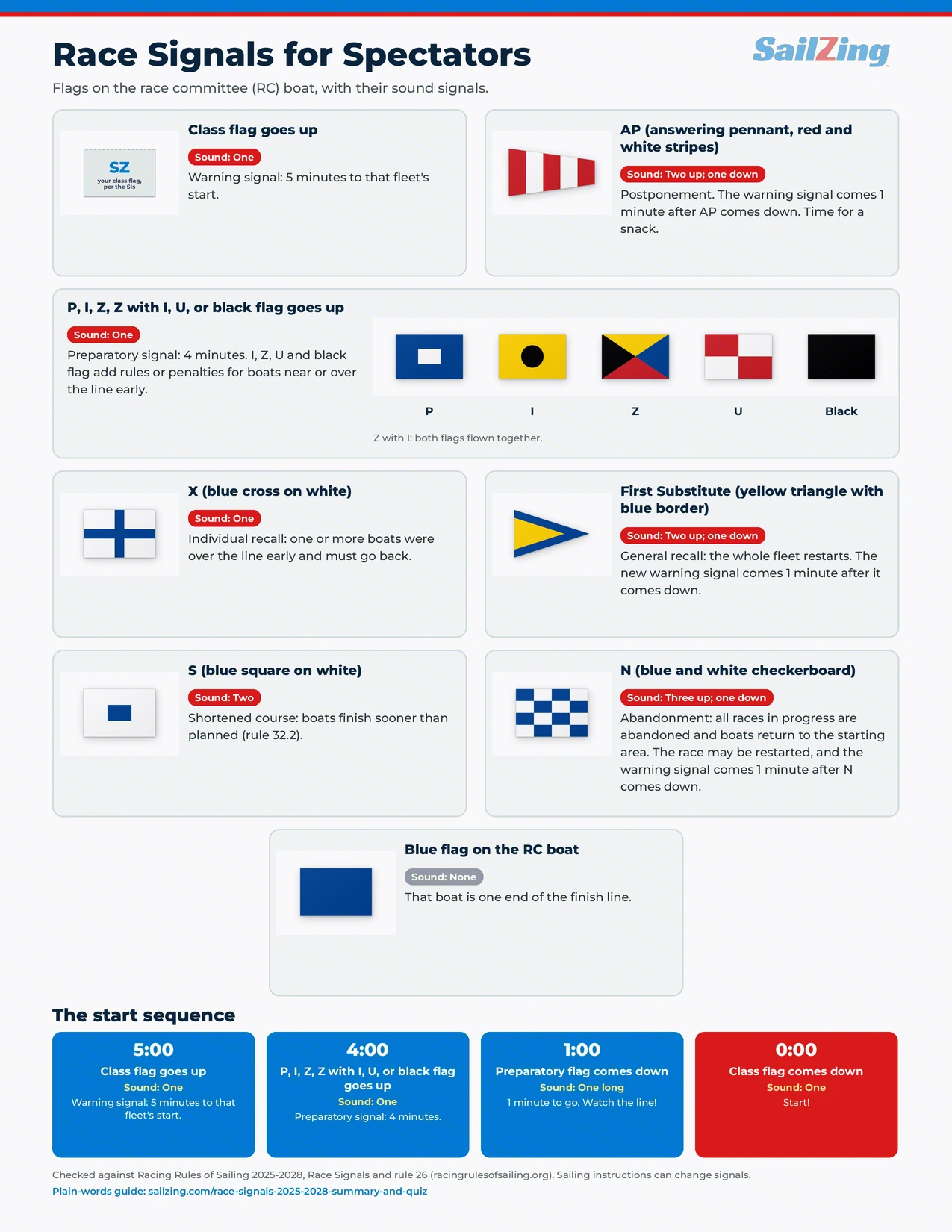
The RC boat talks with flags and sound signals. Learn a few, and you’ll always know what’s going on. The official list is on the Racing Rules of Sailing race signals page, and SailZing.com’s Race Signals 2025-2028: Summary and Quiz explains them in plain words.
| Flag | Sound | What it means for you |
|---|---|---|
| Class flag goes up | One | Warning signal: 5 minutes to that fleet’s start. |
| P, I, Z, Z with I, U, or black flag goes up | One | Preparatory signal: 4 minutes. I, Z, U and black flag add rules or penalties for boats near or over the line early. |
| Preparatory flag comes down | One long | 1 minute to go. Watch the line! |
| Class flag comes down | One | Start! |
| AP (answering pennant, red and white stripes) | Two up; one down | Postponement. The warning signal comes 1 minute after AP comes down. Time for a snack. |
| X (blue cross on white) | One | Individual recall: one or more boats were over the line early and must go back. |
| First Substitute (yellow triangle with blue border) | Two up; one down | General recall: the whole fleet restarts. The new warning signal comes 1 minute after it comes down. |
| S (blue square on white) | Two | Shortened course: boats finish sooner than planned (rule 32.2). |
| N (blue and white checkerboard) | Three up; one down | Abandonment: all races in progress are abandoned and boats return to the starting area. The race may be restarted, and the warning signal comes 1 minute after N comes down. |
| Blue flag on the RC boat | None | That boat is one end of the finish line. |
Who’s Winning? Read the Race From a Distance
Upwind, the boat that looks ahead often isn’t. Boats zigzag toward the windward mark, so the one farthest up the course may be on the wrong side of a wind shift.
#1. Think in ladder rungs
Picture lines across the course at right angles to the wind, like rungs on a ladder. The boat on the highest rung is ahead, no matter how far left or right she is. SailZing.com’s Ladder Rungs post shows this with diagrams.

In the diagram, Blue is one rung ahead of Yellow even though Yellow looks closer to the windward mark from shore.
The ladder isn’t fixed the way the diagram shows it. It tilts with the wind, so the rungs always stay at right angles to the wind direction. When the wind shifts, the rungs swing with it, and a boat that was behind can suddenly be ahead. That’s the fun part to watch: after a big shift, who’s leading can change in a hurry.
#2. Watch for leverage
Leverage is how far apart two boats are sideways across the course. Think back to the ladder: two boats on the same rung but far apart are tied for now, but boats farther apart on a rung are the ones most affected when the wind shifts and the rungs change on them. Big leverage means a big gain or loss. When the fleet splits into a left group and a right group, you’re watching a bet. The next shift decides who cashes in.
#3. Spot the wind shifts
On lakes, the wind swings (shifts) often. Watch the water: dark patches are puffs (stronger wind). When one group suddenly points closer to the windward mark, they got a lift. Learn the cues in Recognizing the Lifted Tack and Favored Side of the Course.
#4. Use the marks as a scoreboard
Mark roundings are the only moments the order is truly clear. Count boats around the windward mark, then again at the leeward gate. The boats that gained are the stories to ask about at the dock.
How to Watch Like a Coach
Racers: spectating is a free clinic. When you’re on the dock with a sore wrist or between fleets, watch with a mission. Coaches pick one thing to watch at a time. Try these:
- Starts. Where did the winners start: near the RC boat, the pin, or the middle? Who had speed at the gun? Compare with Starting for Beginners.
- First beat. Which side paid? Did leaders tack on shifts or sail long? See Windward Leg for Beginners.
- Downwind. Who sailed in the puffs? Which side of the leeward gate did leaders pick? See Downwind Leg for Beginners and Choosing the Leeward Gate.
- Boat handling. Count how long top boats take to accelerate after a tack. Watch crew weight and sail trim through the turn.
- Wind indicators. With binoculars, look at the telltales (yarn or ribbon strips on sails and shrouds that show airflow) and masthead wind indicators. When a whole fleet’s indicators swing together, you just saw a shift. On boats with SailZing StayTales™ or other shroud telltales, you can see the apparent wind angle change from a distance. See Ten Ways to Use Shroud Telltales and Downwind Strategy: Use Apparent Wind Clues.
- Write it down. Jot three notes per race: one thing the winner did, one thing the mid-fleet did, one thing you’ll try next time.
Fair play counts too. Watch how top sailors take penalties and handle close calls. The ILYA’s #FairSailing initiative sets the tone on inland lakes.

Photo Tips and Bringing Kids
Photography:
- Shoot the windward mark and starts. Boats bunch up and the action is close together.
- Get low and downwind. From leeward, you see sails full and crews hiking toward you.
- Use a fast shutter. Scows move quickly and bounce on chop; freeze the motion.
- Backlight is drama. Morning or late-afternoon sun through the sails makes great shots.
- Share and credit. Racers love photos. Tag the sail number, and send them to the club.
Bringing kids:
- Give them a job. Spotting flags, finding a family member’s sail number, or counting boats around a mark keeps them in the game.
- Life jackets on. On any boat or dock edge. Federal rules require kids under 13 to wear one on a boat that’s underway (see the USCG link above).
- Pack for the long haul. Shade, water, snacks, and a backup plan for postponements.
- Make it a learning game. “Which side do you think will win?” turns spectating into strategy.
Spectator Quick Sheet
- Read the NOR/SIs for spectator zones and the course diagram.
- Stay outside the course and out of the pre-start zone below the start line. Watch from green: the sides, above the windward mark, or below the pre-start zone.
- No wake near racers. Follow local no-wake law.
- Never enter the race diamond (start line, side corners, windward mark), and keep clear of the corners.
- Give the RC boat and mark boats a wide berth.
- Stay off the laylines and jibe lanes. Know where boats are headed next, and move early: you’re slower than they are.
- Paddlers: life jacket on, hug the shore.
- Drones: FAA rules, other drones, and the NOR, SIs and venue rules come first.
- If your event offers live tracking, load the link before you leave the dock.
- Learn five flags: class flag (one sound), prep flag (one sound up, one long down), AP, X, and N.
- Upwind, the highest ladder rung leads.
- Count boats at every mark rounding.
- Racers: watch one thing at a time, and write three notes.
Where to Start
Next regatta, start simple. Grab the course diagram, find a spot downwind of the leeward gate, and learn the start sequence flags. Once you can call the start, add binoculars, plus live tracking if your event offers it. Then pick one thing to watch like a coach. You’ll be explaining the race to everyone on the dock before the last lap.
If you’ve found a great spectating spot on your lake, share it in the comments below.
Related Content
- Racing Terms: Glossary for Newer Sailors
- Race Signals 2025-2028: Summary and Quiz
- Ladder Rungs: Understand the Race Course with a Visual Approach
- Sailing the Race Course – Starting for Beginners
- Mainsail Telltales: A Better Approach
- 2022 ILYA Championship Debrief: Race-Course Notes
- Roble/Shea Sailing video series – produced by SailZing in partnership with the ILYA
- Racing Rules of Sailing – Race Signals – World Sailing
- ILYA – Inland Lake Yachting Association
- Melges Performance Sailboats – builder of the MC, C, E and A scows and the Melges 15


