
This post has been updated for the 2025-2028 Racing Rules of Sailing.
Win or lose, do it fairly. – Knute Rockne
Fair Sailing is a key concept in the Racing Rules of Sailing (RRS). What does Fair Sailing actually mean? Do you have to be perfect in following the rules to be a Fair Sailor? Is it OK to go easy on your friends when they break a rule? In this article, we’ll summarize the key points, answer questions, and give examples.
In 2018, the Inland Lake Yachting Association (ILYA) and SailZing, LLC partnered on a Fair Sailing initiative, including a series of articles on the rules. This article is part of that series, updated for 2025-2028.
What Does the Rule Book Say About Fair Sailing?
The RRS 2025-2028 cover Fair Sailing in the Basic Principles and in Rules 2, 4 and 69.
Basic Principles: Sportsmanship and the Rules
Competitors in the sport of sailing are governed by a body of rules that they are expected to follow and enforce. A fundamental principle of sportsmanship is that when a boat breaks a rule and is not exonerated, she will promptly take an appropriate penalty or action, which may be to retire.
World Sailing, Racing Rules of Sailing 2025-2028 (Study Version), Basic Principles. Read it online at racingrulesofsailing.org.
The wording changed for 2025: a boat now takes “an appropriate penalty or action” (2021-2024: “a penalty or action”).
Questions
Read each question and decide your answer. Then reveal the answer to check your thinking.
#1 – You Owe Me One
A friend fouls you. Is it OK to say, “You owe me one”?
Not really. The rules make the game fair for all sailors. You may not be affected much by your friend’s foul, but excusing the foul penalizes other sailors who might have gained while your friend was taking a penalty.
Excusing a competitor also erodes respect for the rules, which is the foundation of our sport.
#2 – Promptly
What does it mean to “promptly” take a penalty? Where is this covered in the rules?
rule 44.2 says, in part: “After getting well clear of other boats as soon after the incident as possible, a boat takes a One-Turn or Two-Turns Penalty by promptly making the required number of turns in the same direction, each turn including one tack and one gybe.”
The two keys are 1) getting well clear of other boats and 2) as soon after the incident as possible.
#3 – Retiring
When is a boat required to retire? Where is this covered in the rules?
rule 44.1(b): “if the boat caused injury or serious damage or, despite taking a penalty, gained a significant advantage in the race or series by her breach her penalty shall be to retire.”
There is no definition of “damage” in the rules. World Sailing Case 19 quotes a dictionary: “harm . . . impairing the value or usefulness of something,” and suggests asking questions such as: “Was the current market value of any part of the boat, or of the boat as a whole, diminished?” and “Was any item of the boat or her equipment made less functional?”
Rule 2 – Fair Sailing
A boat and her owner shall compete in compliance with recognized principles of sportsmanship and fair play. A boat may be penalized under this rule only if it is clearly established that these principles have been violated. The penalty shall be a disqualification that is not excludable.
World Sailing, Racing Rules of Sailing 2025-2028 (Study Version), Part 1. Read it online at racingrulesofsailing.org.
Questions
Read each question and decide your answer. Then reveal the answer to check your thinking.
#4 – Breaking a Rule
If I break a rule, can I still be a Fair Sailor?
Yes, if your action was unintentional and you take your penalty. No one expects you to follow all the rules all the time.
#5 – Rule 2 Examples
What are some examples of breaking Rule 2?
Case 138: “Generally, an action by a competitor that directly affects the fairness of the competition or failing to take an appropriate penalty when the competitor is aware of breaking a rule, should be considered under rule 2.”
Case 47: “A boat that deliberately hails ‘Starboard’ when she knows she is on port tack has not acted fairly, and has broken rule 2.”
Case 73: “When, by deliberate action, L’s crew reaches out and touches W, which action could have no other intention than to cause W to break rule 11, then L breaks rule 2.”
#6 – DNE
If I see DNE on the results, what does that mean?
DNE (see Sailing Scoring Notations) is a disqualification that can’t be your throwout: even if your series lets you drop your worst race, a DNE must count in your series score (rule 90.3(b)).
The usual cause is a breach of Rule 2: the protest committee finds a boat clearly broke the principles of sportsmanship and fair play, for example by deliberately fouling someone or cheating to gain places, and Rule 2 says that penalty “shall be a disqualification that is not excludable.”
For misconduct under Rule 69, the protest committee may also choose to make a disqualification one that can’t be excluded.
Ordinary mistakes are not DNE: a right-of-way foul you didn’t take a penalty for (DSQ), OCS, UFD and a normal BFD can all be your throwout (the one exception: if you’re black-flagged and sail in the restarted race anyway, Rule 30.4 says that disqualification can’t be excluded).
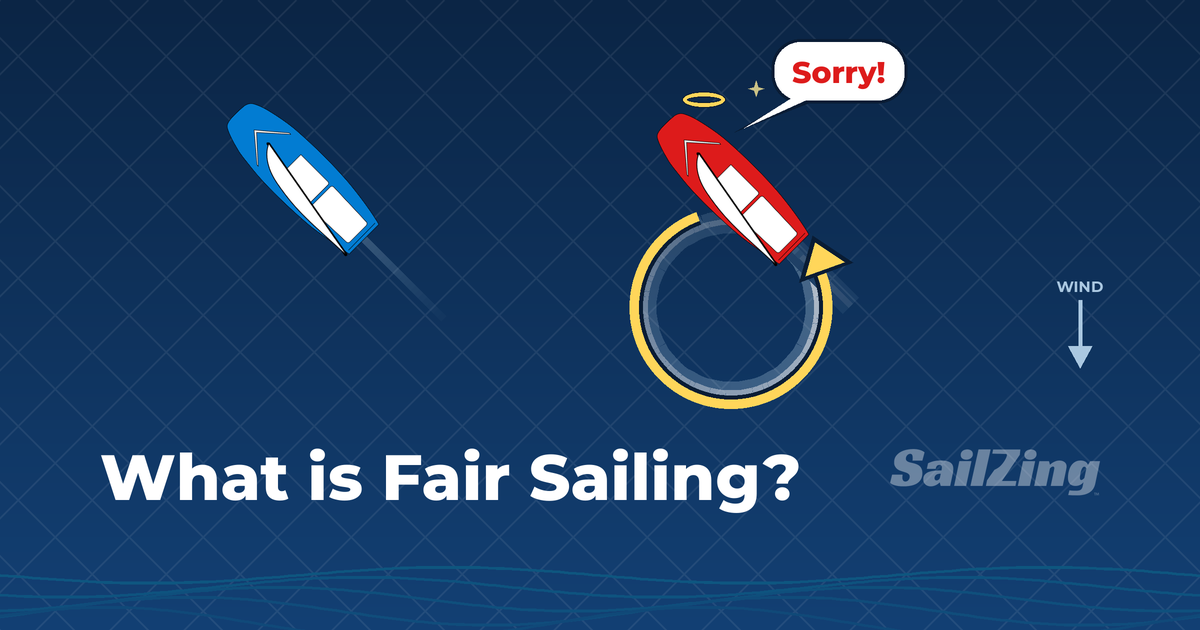
Example: a boat that hails “Starboard” when she knows she is on port, to make a rival duck, has broken Rule 2 (World Sailing Case 47), and under Rule 2 that penalty is a DNE. Call it the “no halo rule”: for an ordinary foul, your penalty turn (the halo you sail around yourself) clears you, but no amount of circling earns back a deliberate unfair act, and its DNE can’t be dropped from your score.
Rule 4 – Acceptance of the Rules
4.1 (a) By participating or intending to participate in an event conducted under the rules, each competitor and boat owner agrees to accept the rules.
World Sailing, Racing Rules of Sailing 2025-2028 (Study Version), Part 1. Read it online at racingrulesofsailing.org.
(b) A support person by providing support, or a parent or guardian by permitting their child to enter an event, agrees to accept the rules.
4.2 Each competitor and boat owner agrees, on behalf of their support persons, that such support persons are bound by the rules.
4.3 Acceptance of the rules includes agreement
(a) to be governed by the rules;
(b) to accept the penalties imposed and other action taken under the rules, subject to the appeal and review procedures provided in them, as the final determination of any matter arising under the rules;
(c) with respect to any such determination, not to resort to any court of law or tribunal not provided for in the rules; and
(d) by each competitor and boat owner to ensure that their support persons are aware of the rules.
4.4 The person in charge of each boat shall ensure that all competitors in the crew and the boat’s owner are aware of their responsibilities under this rule.
4.5 This rule may be changed by a prescription of the national authority of the venue.
Questions
Read each question and decide your answer. Then reveal the answer to check your thinking.
#7 – Support Person
What is a support person?
From the RRS Definitions: “Support Person Any person who (a) provides, or may provide, physical or advisory support to a competitor, including any coach, trainer, manager, team staff, medic, paramedic or any other person working with, treating or assisting a competitor in or preparing for the competition, or (b) is the parent or guardian of a competitor.”
#8 – Coaches
Can a coach who is not racing be penalized under the rules?
Yes. rule 62.3: “If the protest committee decides that a support person who is a party to the hearing has broken a rule, it may (a) issue a warning, (b) exclude the person from the event or venue or remove any privileges or benefits, or (c) take other action within its jurisdiction as provided by the rules.”
Under rule 62.4, the protest committee may also penalize the boat, “up to and including disqualification,” if the boat may have gained a competitive advantage from the breach, or if the support person broke a rule again after the boat was warned in writing.
Rule 69 – Misconduct
69.1 Obligation not to Commit Misconduct; Resolution
World Sailing, Racing Rules of Sailing 2025-2028 (Study Version), Part 5, Section C. Read it online at racingrulesofsailing.org.
(a) A competitor, boat owner or support person shall not commit an act of misconduct.
(b) Misconduct is:
(1) conduct that is a breach of good manners, a breach of good sportsmanship, or unethical behaviour; or
(2) conduct that may bring, or has brought, the sport into disrepute.
(c) An allegation of a breach of rule 69.1(a) shall be resolved in accordance with the provisions of rule 69. It shall not be grounds for a protest.
Questions
Read each question and decide your answer. Then reveal the answer to check your thinking.
#9 – Misconduct Examples
What are some examples of misconduct?
World Sailing Case 138, Answer 1: “Rule 69 covers all acts of misconduct, and may range from a very minor misdemeanour to a very significant act of bad sportsmanship or bringing the sport into disrepute. The following actions should be considered as examples of acts of misconduct, but they are not exclusive examples and this is not a definitive list:”
- Engaging in any unlawful activity (for example, theft, assault, criminal damage)
- Engaging in any activity which may bring the sport into disrepute
- Bullying, discriminatory behaviour and intimidation
- Physical or threatened violence
- Acting recklessly or in manner that does, or is likely to, cause damage or injury
- Disobeying the reasonable instructions of event officials
- Intentionally breaking a rule or inciting others to break a rule
- Interference with another competitor’s equipment
- Repeated breaches of a rule
- Failing to act to prevent your boat or team breaking a rule when you are aware of that breach
- Not telling the truth or the whole truth in a hearing
- Other forms of cheating such as falsifying personal, class or measurement documents, entering a boat known not to measure, missing out a mark to gain places, etc.
- Foul or abusive language that causes or may cause offence
- Making abusive or disrespectful comments concerning race officials or their decisions (including via electronic means such as social media)
#10 – Reporting Misconduct
What should I do if I see misconduct at a sailing event?
You can report the incident to the protest committee or the organizing authority for the event.
US Sailing has zero tolerance for abuse and misconduct, both on the water and ashore, in any part of its programs. If you witness or suspect a violation of SafeSport policy, you can report it, including through a form on the US Sailing website.
Summary
Fair Sailing doesn’t mean being perfect. It means following the rules, taking your penalty promptly when you break one, and never cheating or excusing others. Rule 2 and Rule 69 deal with the serious cases.
